

As I mentioned in our last post, Kathleen got our quince preserved last week, however, over the weekend we came into possession of another 15 Lbs or so of quince from a neighbor’s tree.
Monday and Tuesday we have not been able to take the school on the road to the farm due to the construction that was planned, and the number of things we needed to get done at the house, so we took advantage of being home all day on Tuesday to process those quince.
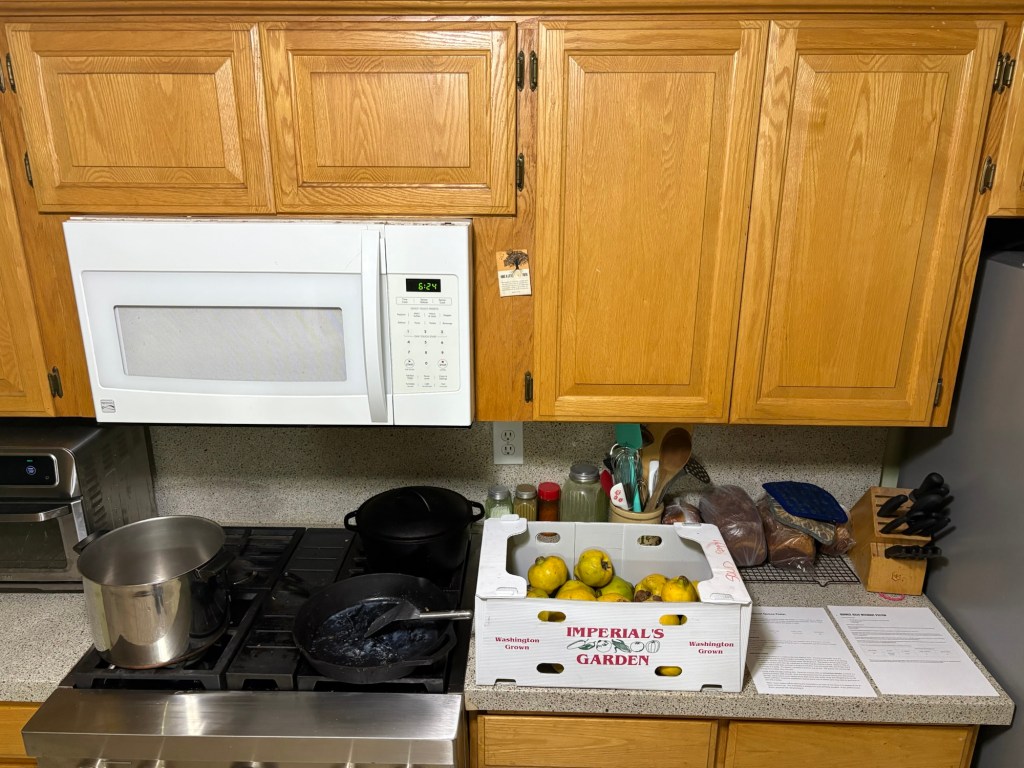
The plan is quince jelly, which by all accounts is quite delicious. The recipe is from the National Center for Home Food Preservation, so my guess is it should be trustworthy. However, when you juice a fruit for jelly it inevitably leaves a huge mass of pulp behind. We could just feed it to the pigs, but while wandering the internet for quince recipes I found that there is a quince “cheese” or paste that is popular in Spain and the Philippines. It is called “Membrillo” and apparently is quite good on goat cheese and as a snack around Christmas time. This recipe is on the internet, and so it is also probably just fine.
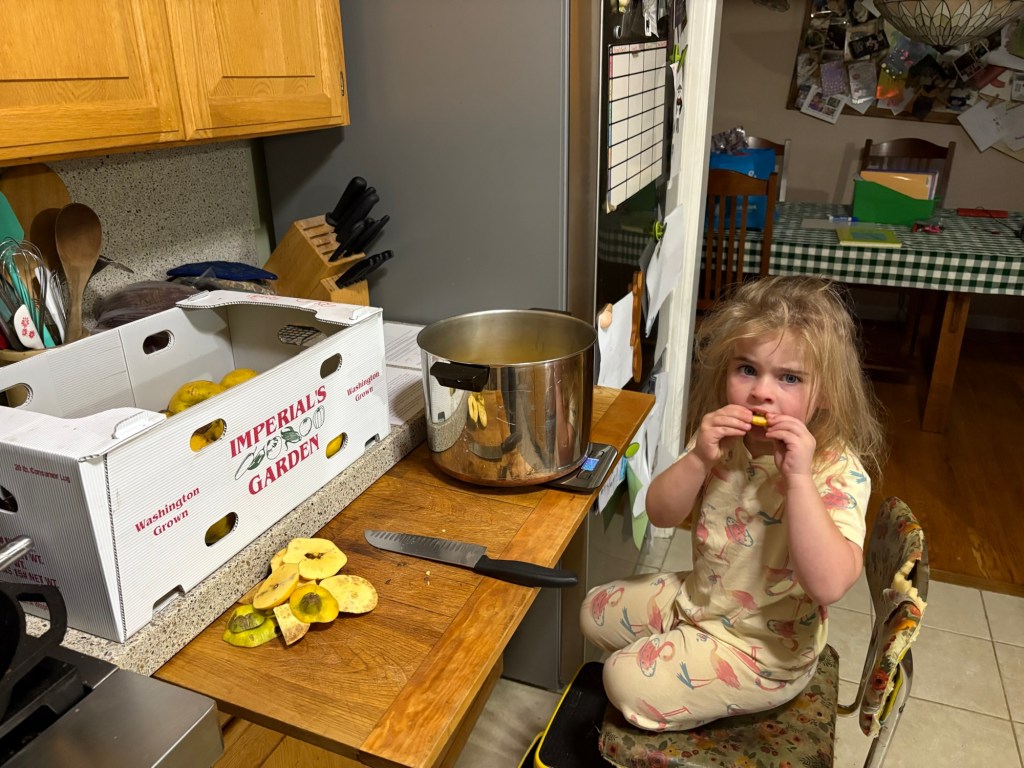
All the authorities insist that quince is too sharp and astringent to be eaten raw. Winnie has not read any of those authorities. She ate several chunks of quince raw while we were cutting them up.
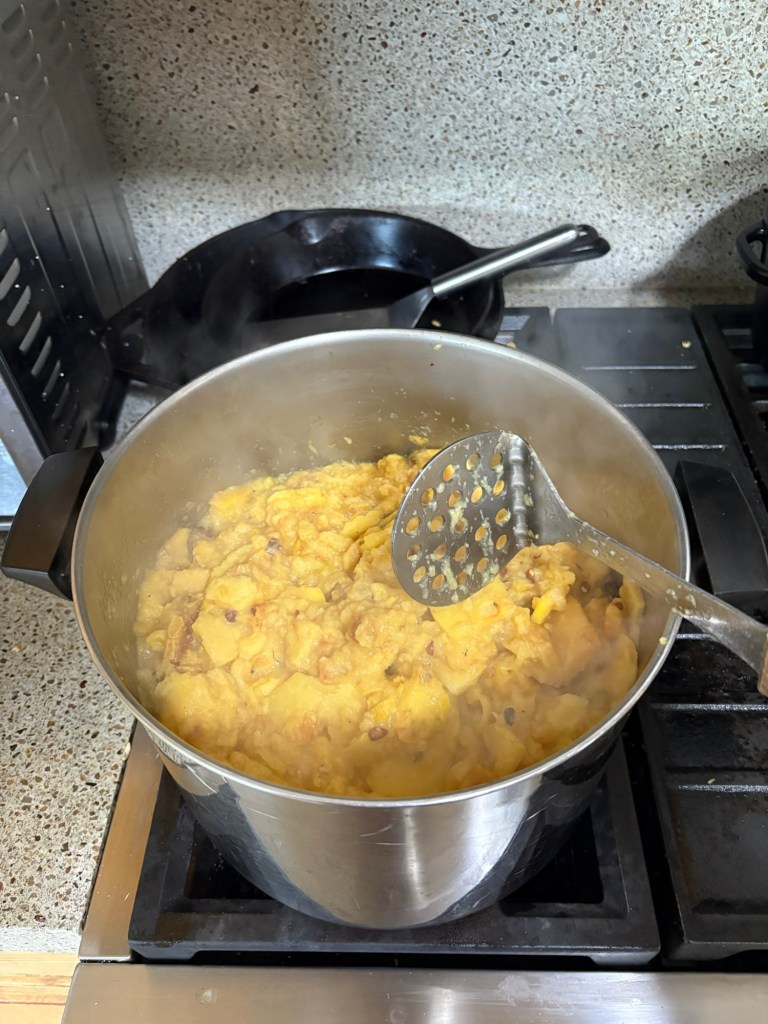
The first batch was boiled down for juice extraction. There were two unripe (still slightly green) quince in the box, so those were chopped up and dropped into this batch. The unripe quince is higher in natural pectins.
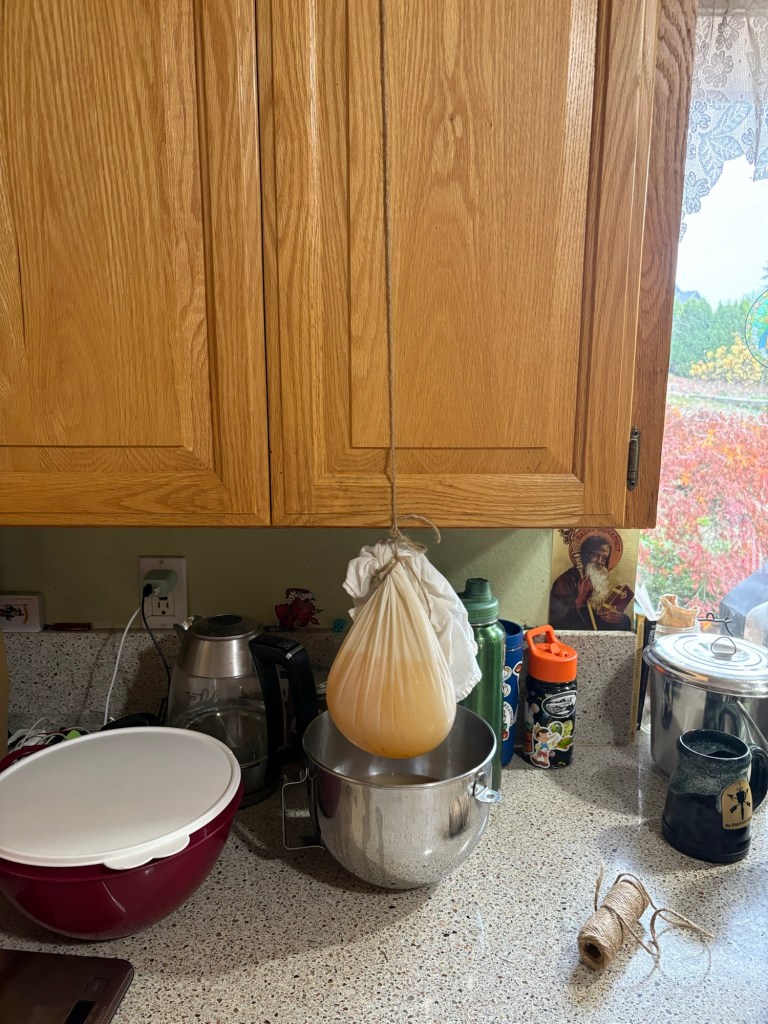
This is our patent pending method for extracting juice. This is not cheese cloth, this is a hemmed linen square, which has a much finer weave than does cheese cloth. The upside to this is that it strains the juice much more cleanly than cheese cloth does. The downside is that if gets clogged very quickly and stops flowing. The solution is two-fold:
- sequential straining. First the whole batch is poured into a colander, which filters out the big globs of mash. Then the resulting fluid is poured through cheese cloth (if we have any handy, we didn’t so we skipped that step). Then it is poured through the linen square. Then, if we want it really clear, we can pour it through a coffee filter. We did this for some of the cordial, but it takes forever so we didn’t worry about it for the jelly.
- Keep it moving. Once it is in the linen, the pectin clogs up the fabric pretty quickly, so we make a bag of the square and roll the fluid around inside that square so it is always coming into contact with fresh areas of cloth. After all the fluid is dripped through, there is a slimy, gelatinous film over the whole inside of the cloth. This is natural fruit pectin. You could wring it out into the juice, but you would risk pushing the sediment that you just spent all that time and effort straining out, through the weave and back into the juice. And, as it turned out, there was plenty of pectin.
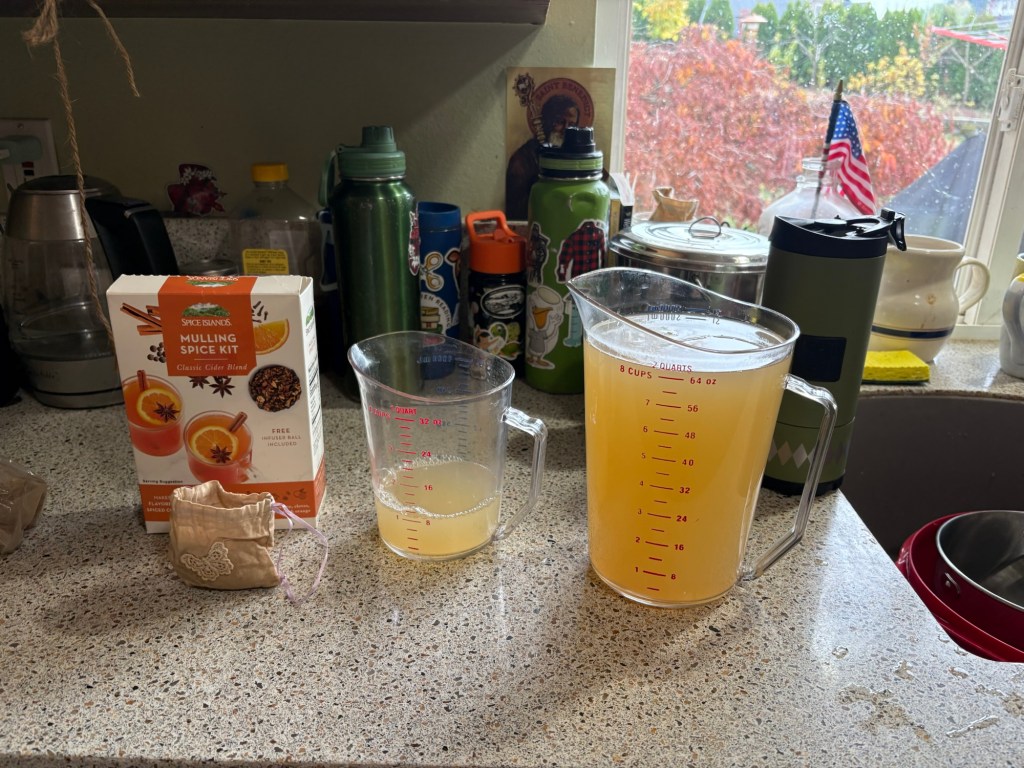
Just over nine-cups of juice from the first batch, plus some mulling spices. You’ll note the juice is a yellowish color.
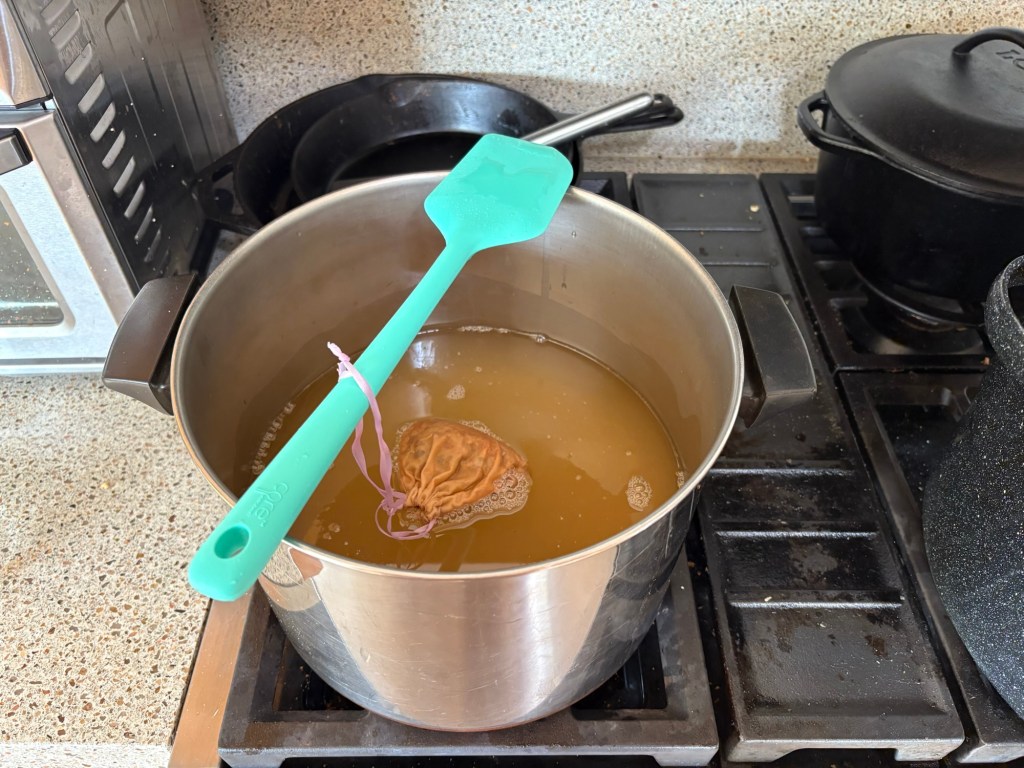
Started it simmering with the mulling spices in a steeping bag. Still a yellowish color. However…
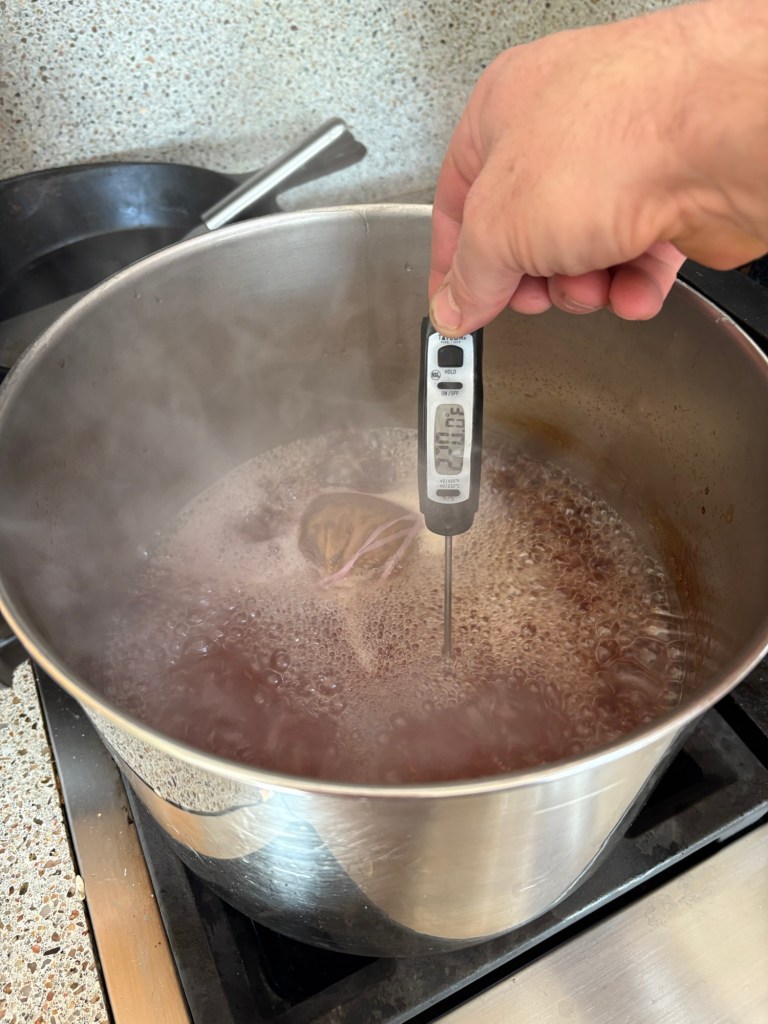
By the time it is boiled to 220 degrees, it has turned a deep red color. You may be wondering, how is it at 220 degrees, when the boiling point of water is 212 degrees? The answer is that as water content boils off, the viscosity of the liquid goes up until until it is more of a syrupy texture. This alters the boiling point higher, just as it would raise the freezing point.
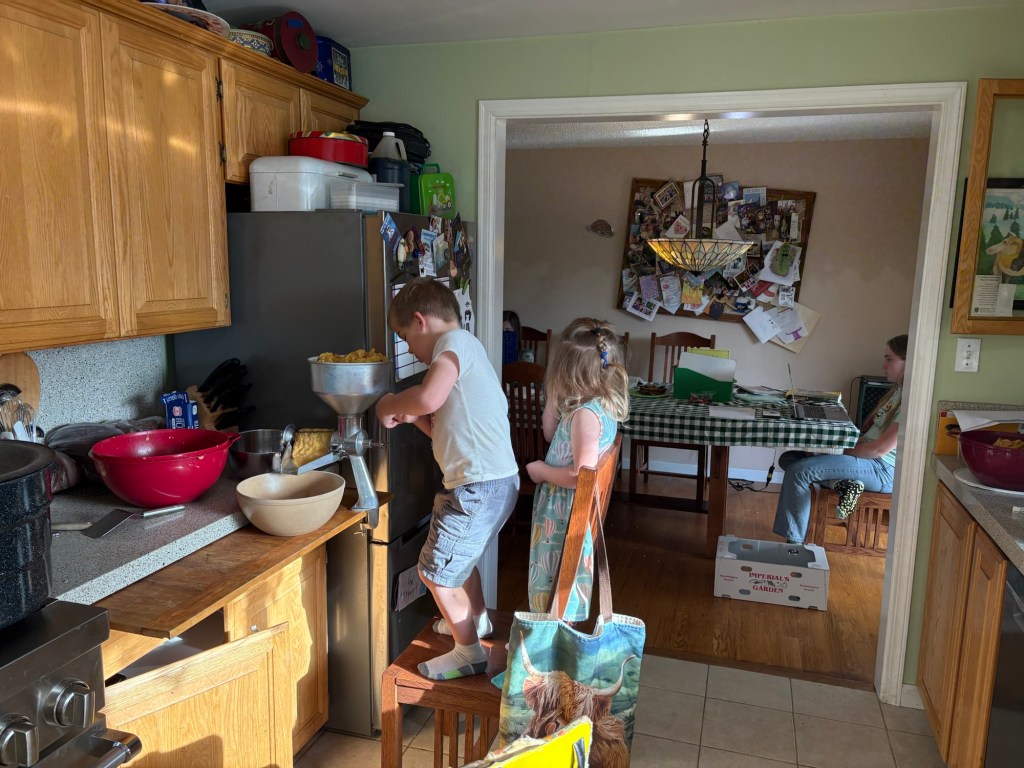
Meanwhile we simmered the rest of the quince and set up the squeezo to puree the rest of the pulp. The recipe called for blending it until smooth. However, it also said to start with the flesh of peeled and cored quince. However that seemed like more prep work than I had time for in the midst of breakfast and school, so we opted just to boil them soft and then run them through the squeezo.
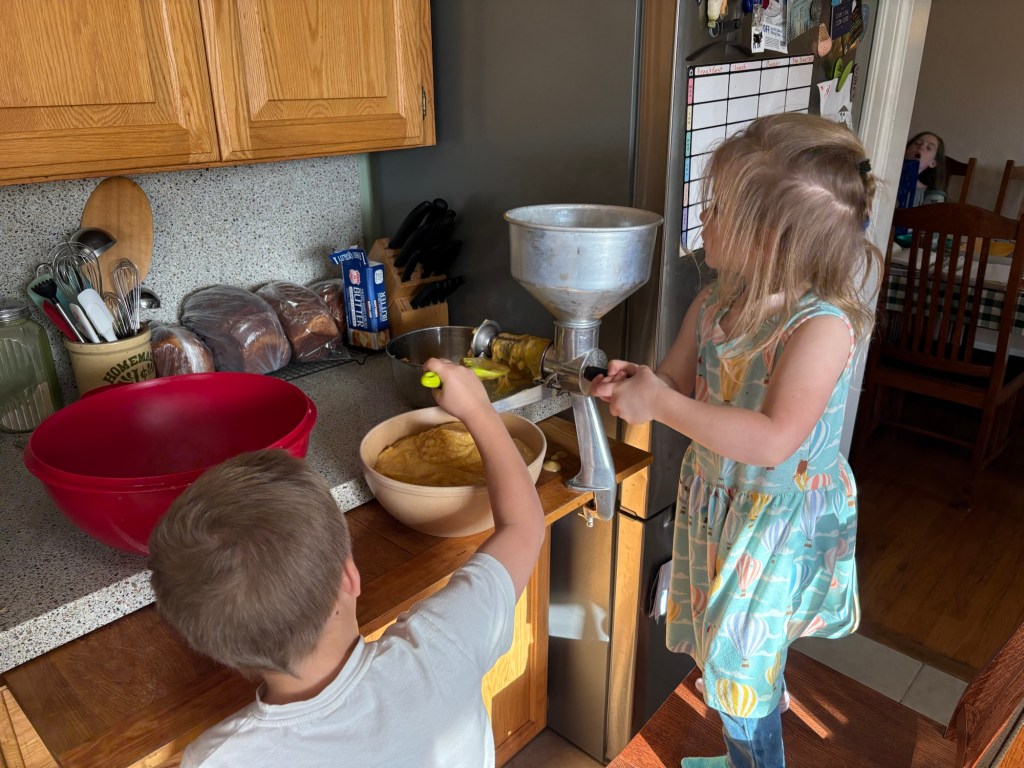
This does a great job of removing the skins and peels, and it is fun for the kids.
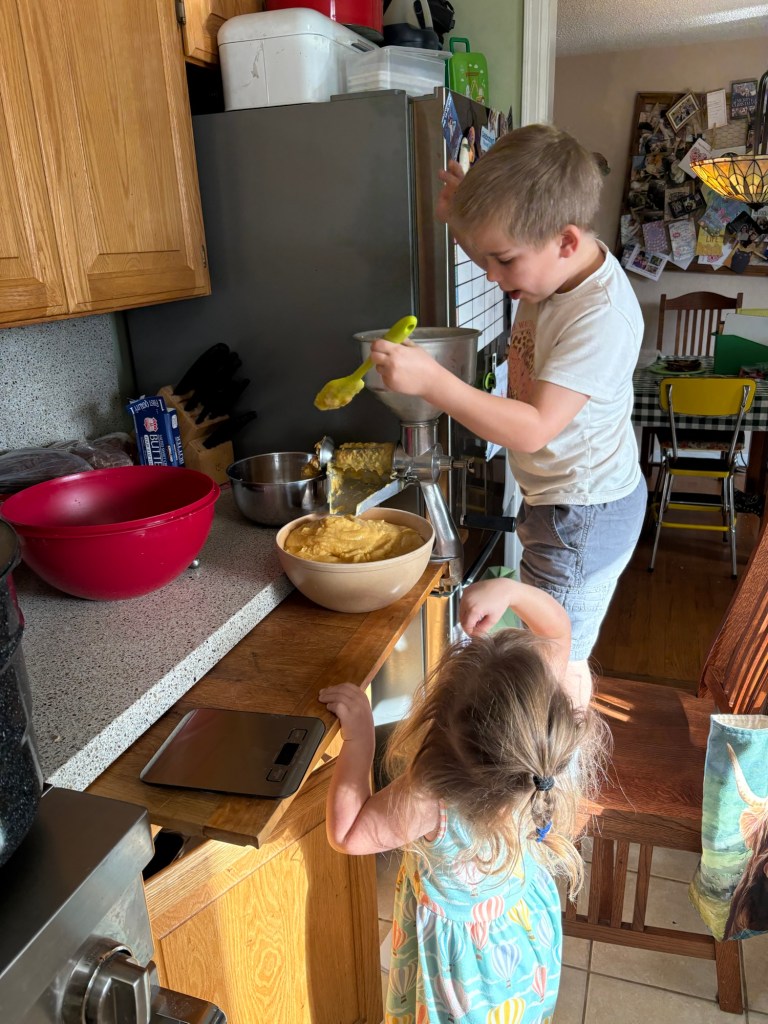
They also like being taste testers (this is before any sugar was added).
Notice, once again, the puree is very yellow. I also noted it had a grainy texture, and there were tiny, hard white grains stuck in the mesh of the squeezo. Perhaps that is a downside of this method. An advantage to it, however, is that it allowed us to boil it with the skins and seeds in, so hopefully to increase the pectin content.
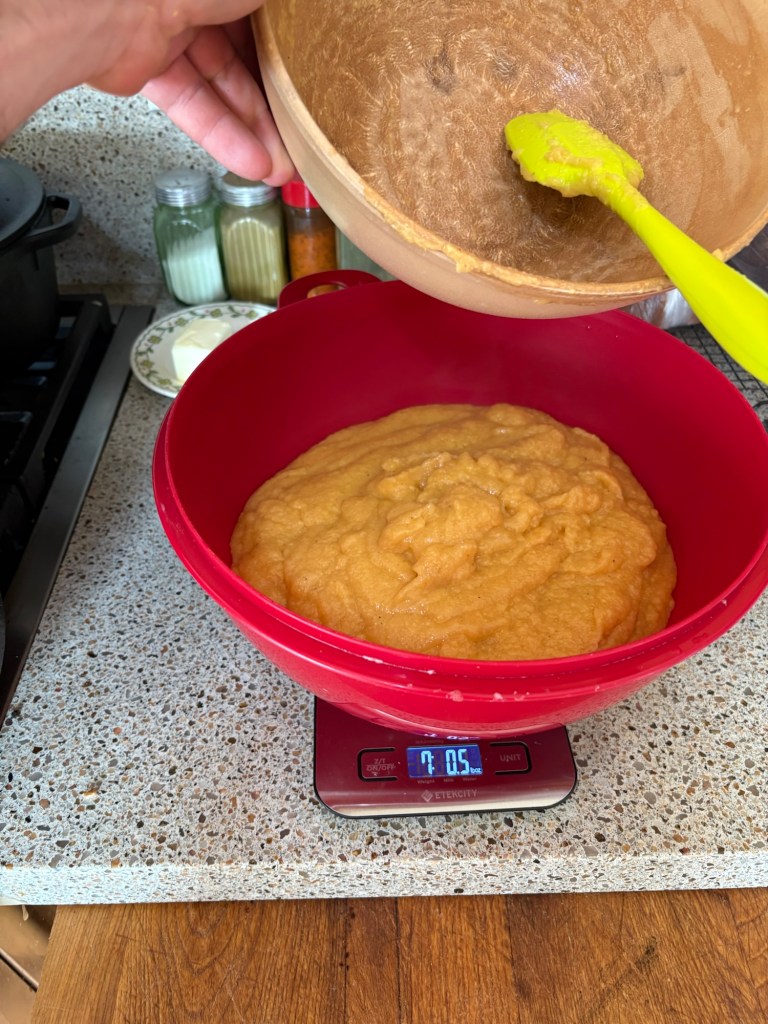
We then added the sugar and lemon juice and set it to simmer on a back burner, while we processed the jelly.
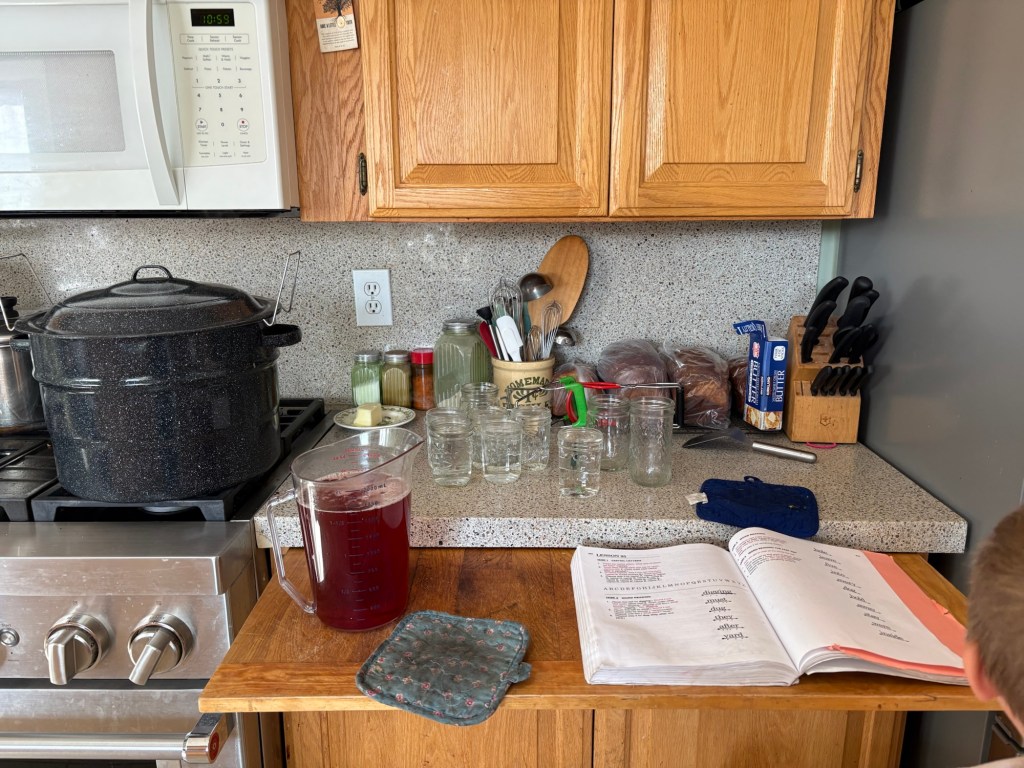
By now the juice had simmered to the point that it was wrinkling on the cold plate. The volume was down to about 7 cups total and it had turned into a deep, ruby red, almost transparent. We poured this into hot jelly jars and set it to water bath.
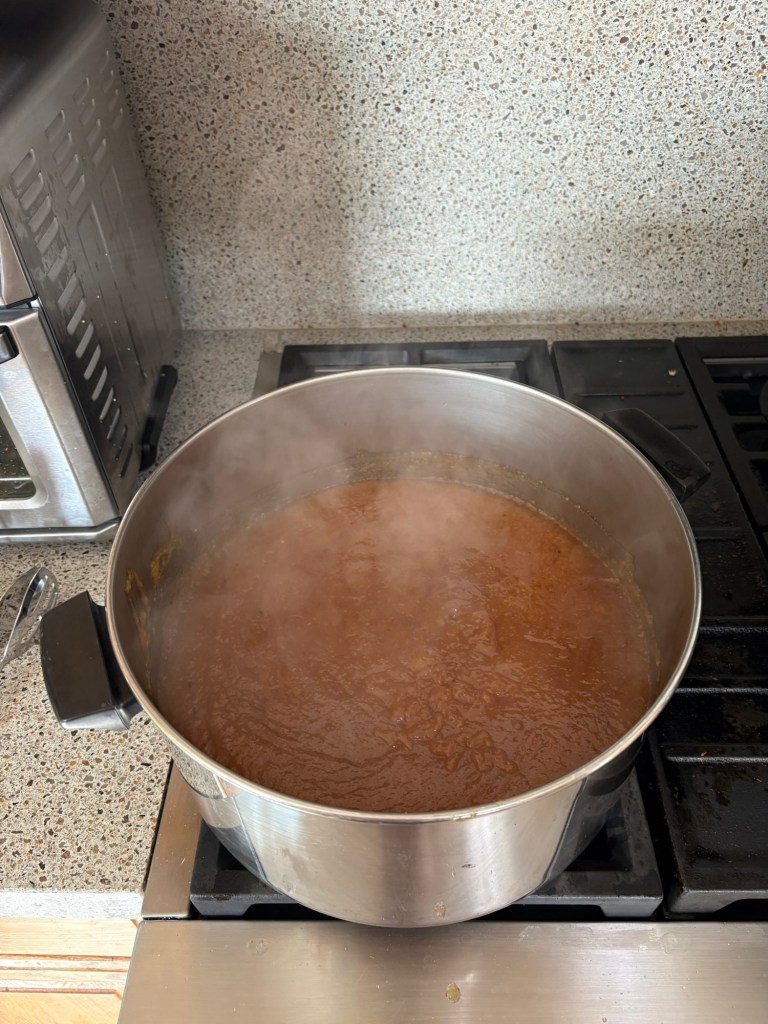
The puree continued to heat and we moved it to the front burner.
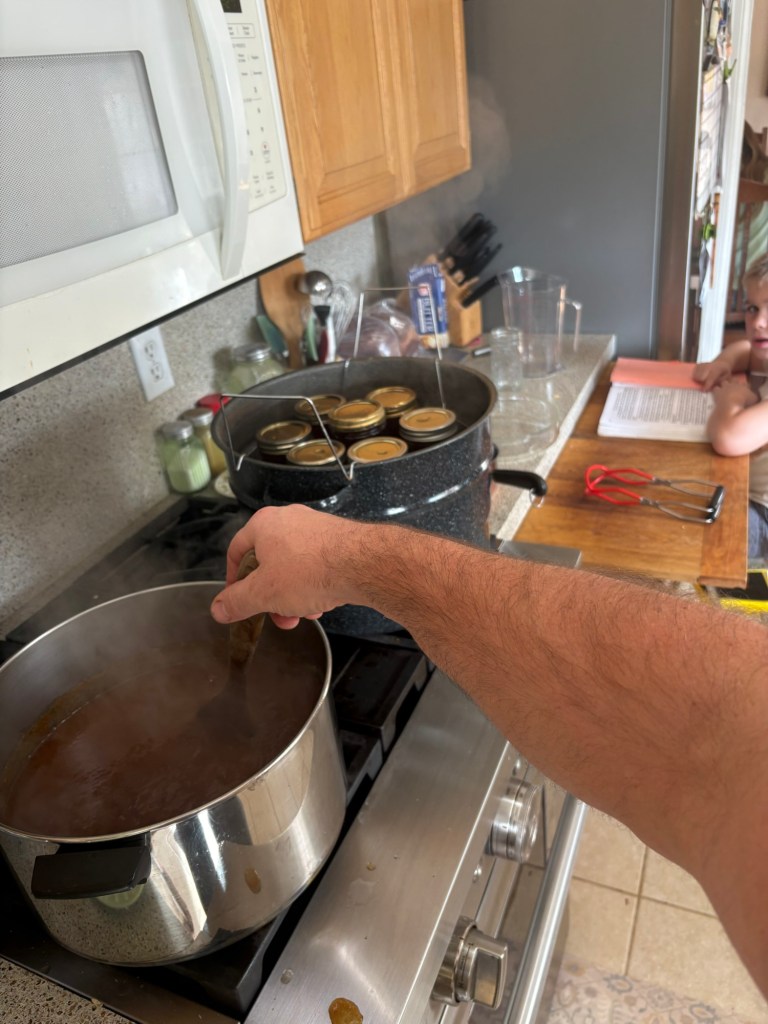
This was extremely tedious. It took an hour and a half for it to boil up to 208 degrees.
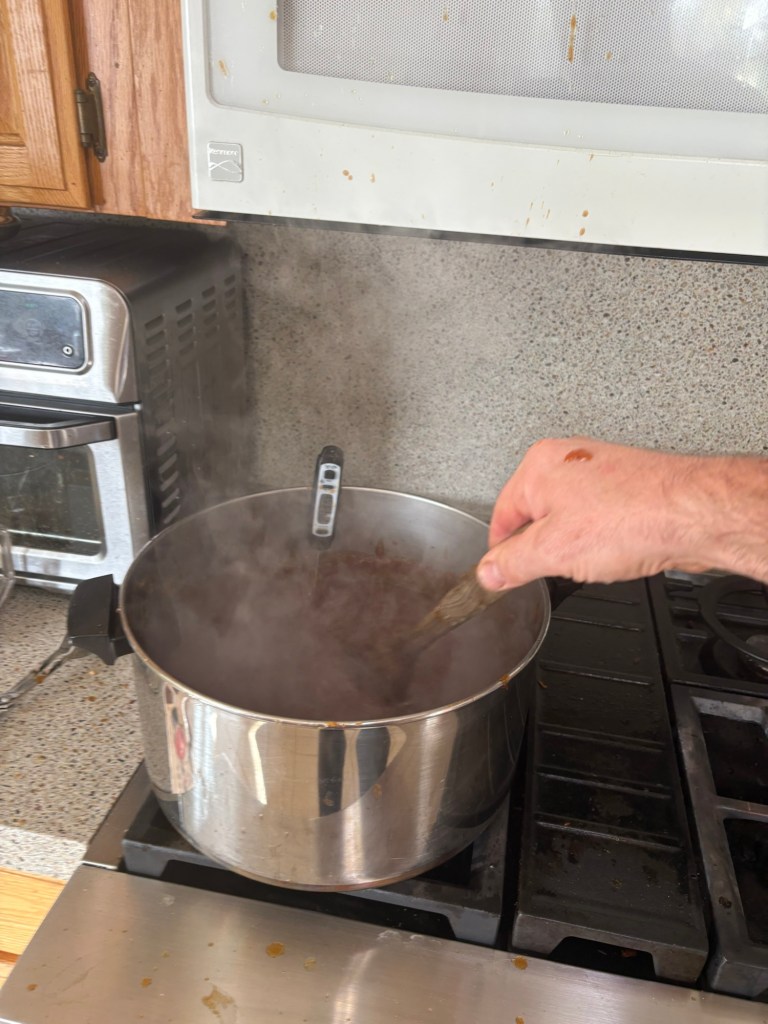
And it was messy. And painful. It kept blowing up large bubbles that popped and showered hot puree everywhere. It never did hit the recommended 220 degrees, but at 208 it was jelling like a boss on the cold plate.
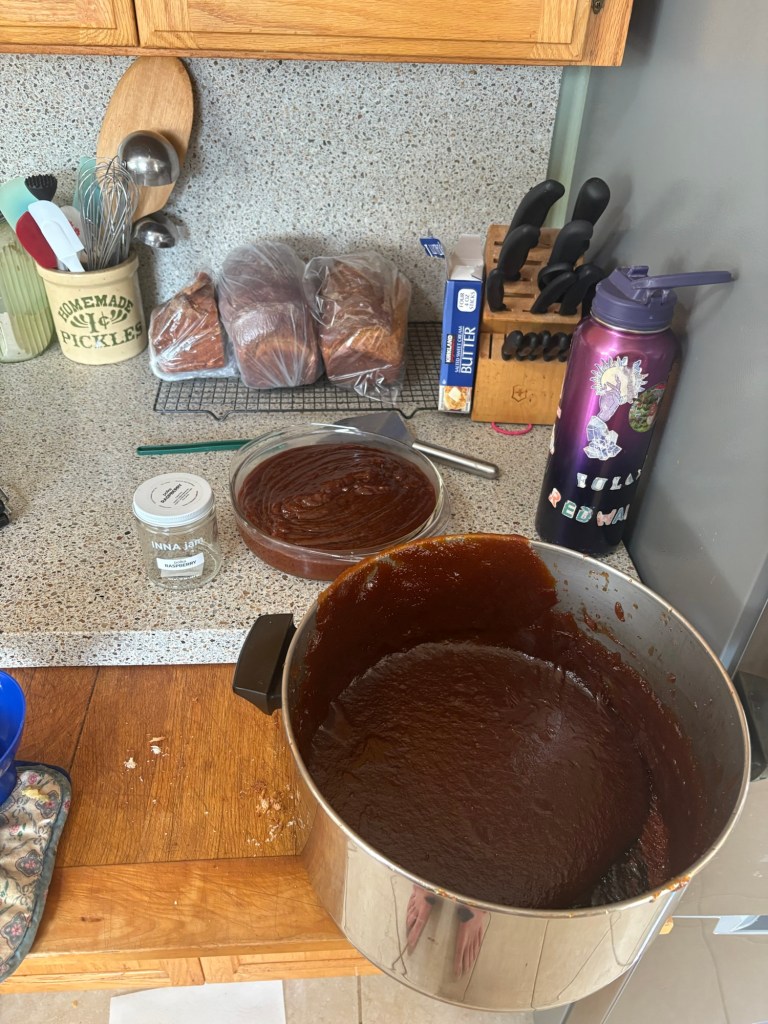
We poured a bunch into a 9″ round. This will be sliced and wrapped in cellophane later.
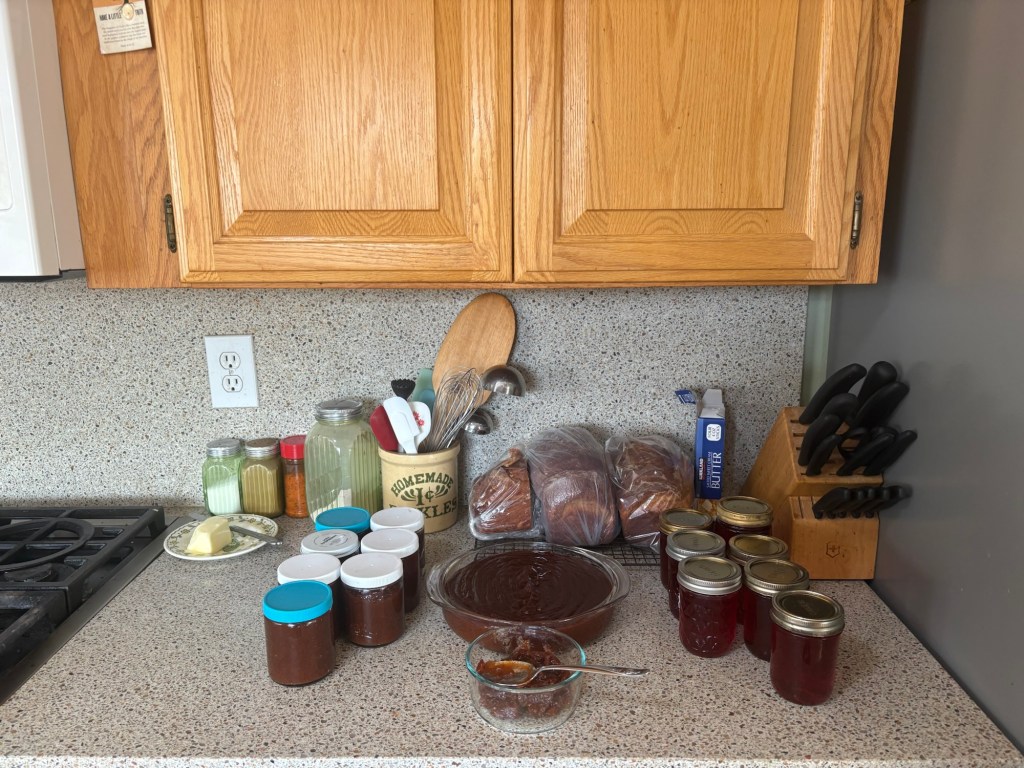
The rest we poured into freezer jam jars, except for the last little bit we saved for supper.
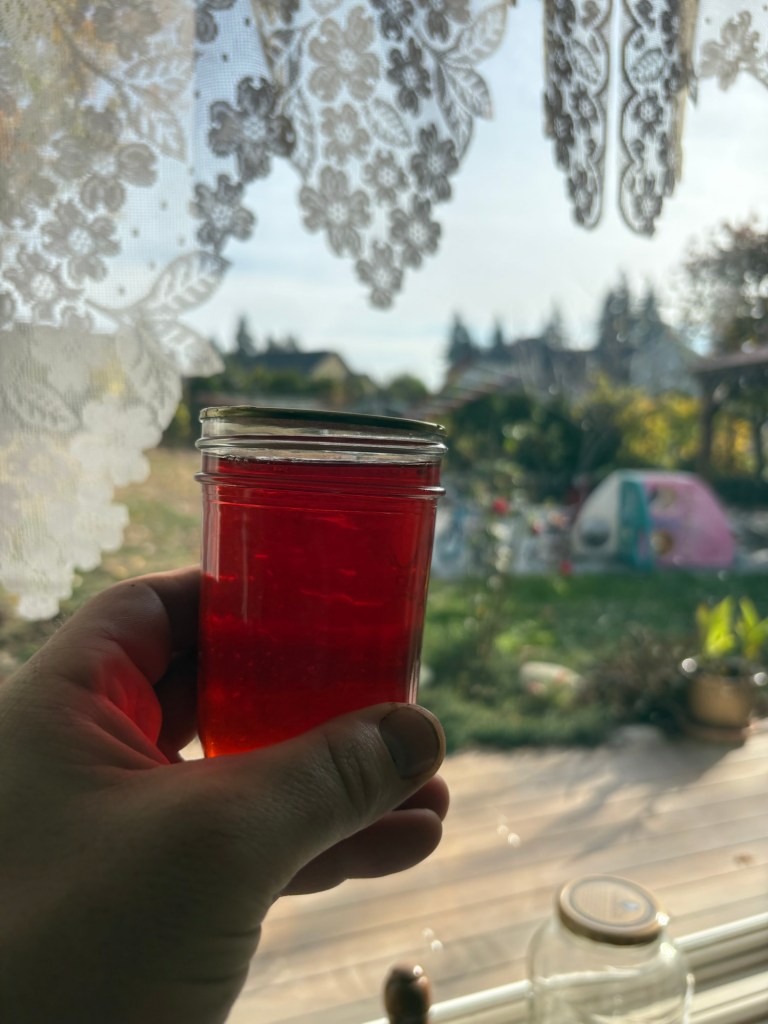
Nice color. Not Washington State Jelly Champion nice, but she was at work, so it was just an understudy making this jelly, so, not too bad.
After an hour on the counter, the membrillo set up like this:
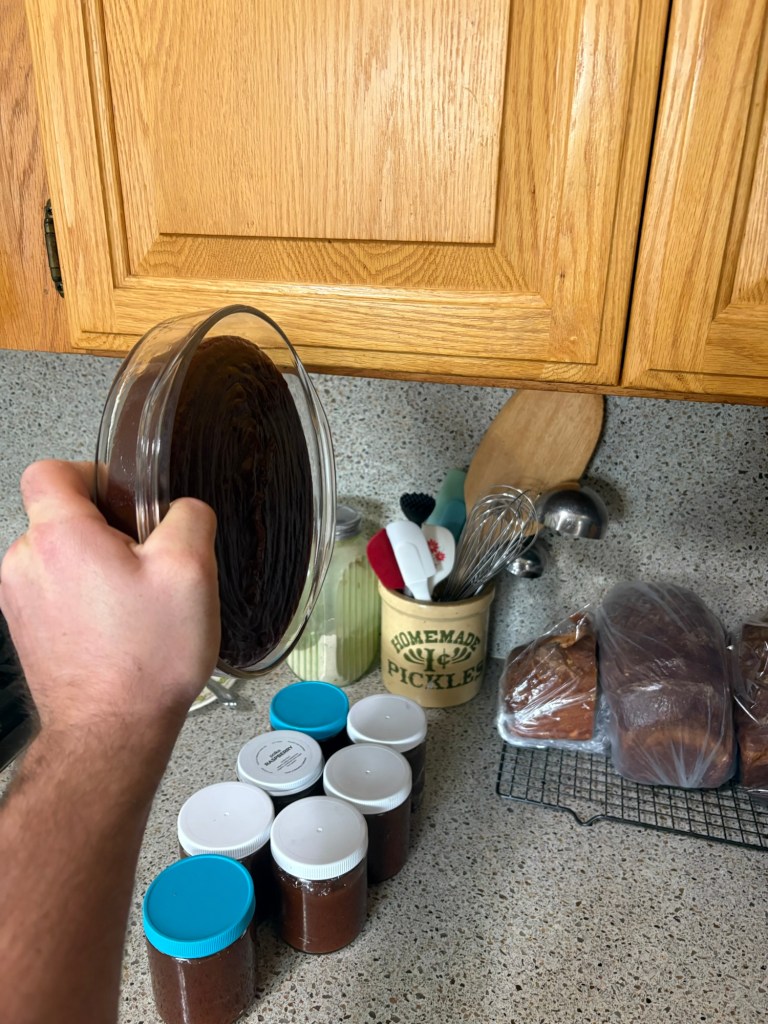
As advertised, firm and sliceable.
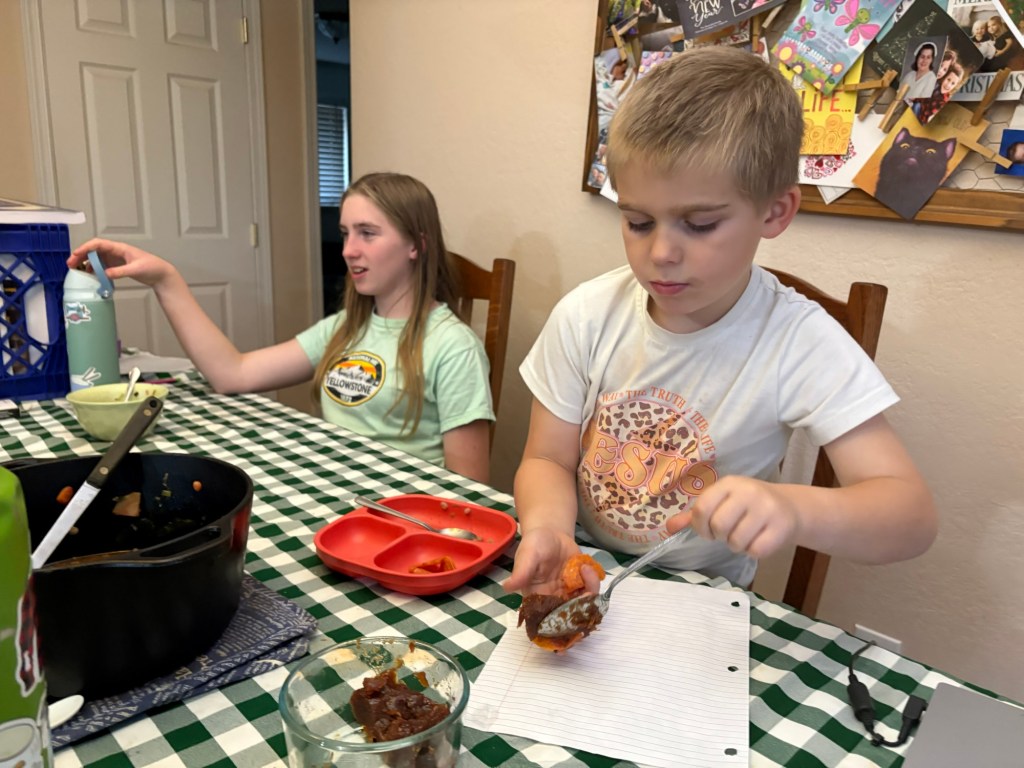
Seppi sliced some of it for supper. He had it sandwiched on pepperoni. It has a fruity, rich flavor that sneaks up on you slowly, not overly sweet.
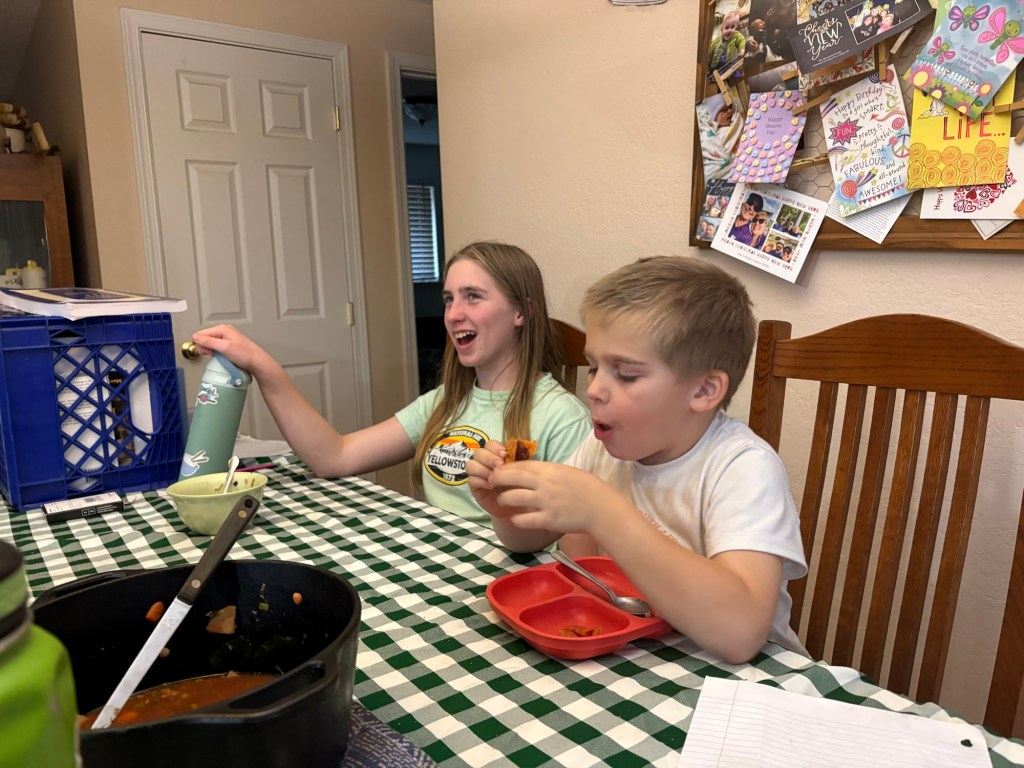
The kids seemed to like it, because they ate all of the extras that we had. So that’s good.


