

This was the first year we have gotten a decent crop of elderberries from the farm. So far we have only been harvesting from the black elder shrub, and have already gotten a huge haul. These are the elderberries we pruned back to the stump in early 2024. They grew out shoots in 2024, and then the shoots flowered and fruited in 2025. This winter we will try to cut back all the shoots that fruited this year, leaving the rest to fruit next year.

Cleaning the elderberries can be tedious. They are small, and until they are quite ripe the drupes (the technical term for the individual fruit) adhere quite firmly. The ripe ones come off quite easily, so there is a technique for rolling the bunches between your fingers so that the ripe ones come off, and the unripe ones mostly stay in place. This is useful for getting them ready to dehydrate. It is not strictly necessary for steam juicing. However, the ripe ones are also fairly delicate, and it is easy to crush them with too much pressure.

Even for steam juicing it can be helpful to separate the unripe drupes. If there are too many unripe berries in the clusters, they can make the juice more tart.
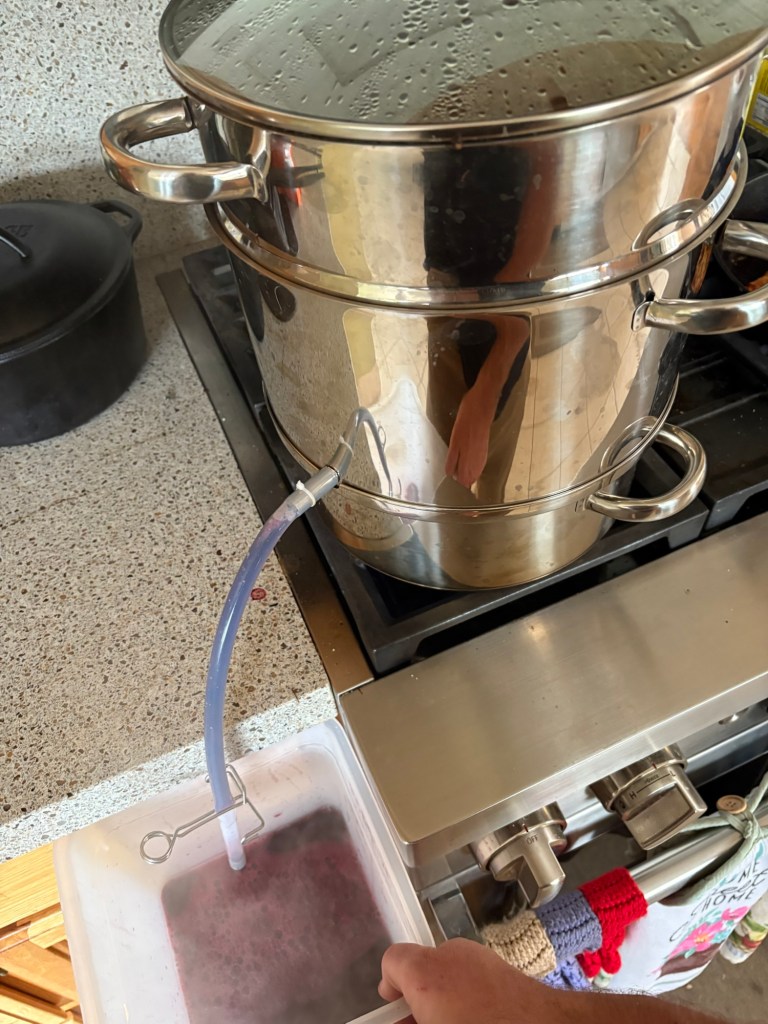
Steam juicing is the The MOST efficient method for extracting juice. It is amazing how quick and hands off it is.

It is especially hands off once Kathleen figured out “The Clothespin Trick ™.” So simple and elegant.
One pan of fresh elderberries in clusters yielded about 5 1/2 quarts of juice.

And left behind some cooked berry pulp to be fed to the pigs. The other advantage of steam juicing, particularly for elderberries, is that it cooks them. Elderberries contain a cyanogenic glycosides which when ingested can produce hydrogen cyanide (just in case you’ve never read a detective story, cyanide is poisonous). The berries, if eaten raw, can cause nausea and even vomiting. Drinking a lot of the juice has put people in the hospital. Cooking the berries neutralizes the toxins, so that the piggies can eat the leftovers.
That being said, most of the toxins are in the leaves, stems, unripe berries and in the seeds. That’s why we want to be careful about cleaning the berries thoroughly and not using a mechanical grinder that could possibly crush seeds as well.
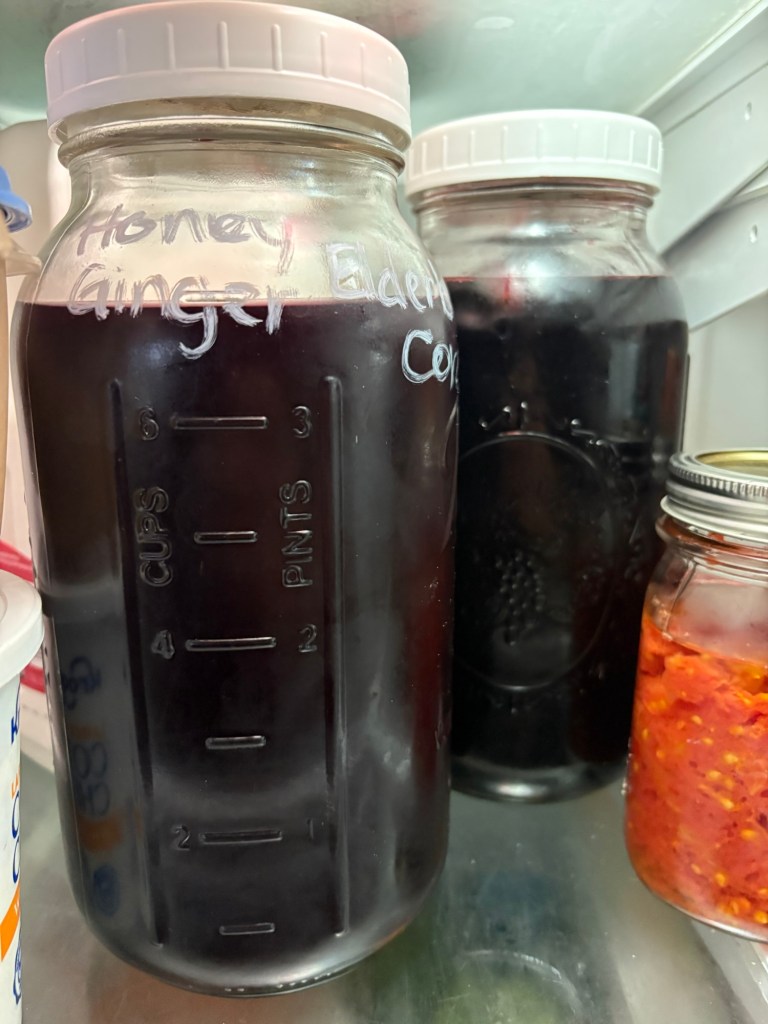
Because the juice from elderberries (other than the blue elderberry) is higher than 4.6 pH it should not be water-bathed, or canned using any high acid recipe. It must be frozen, and can only stay refrigerated for a few weeks.
Unless it is mixed with 100 proof vodka first!
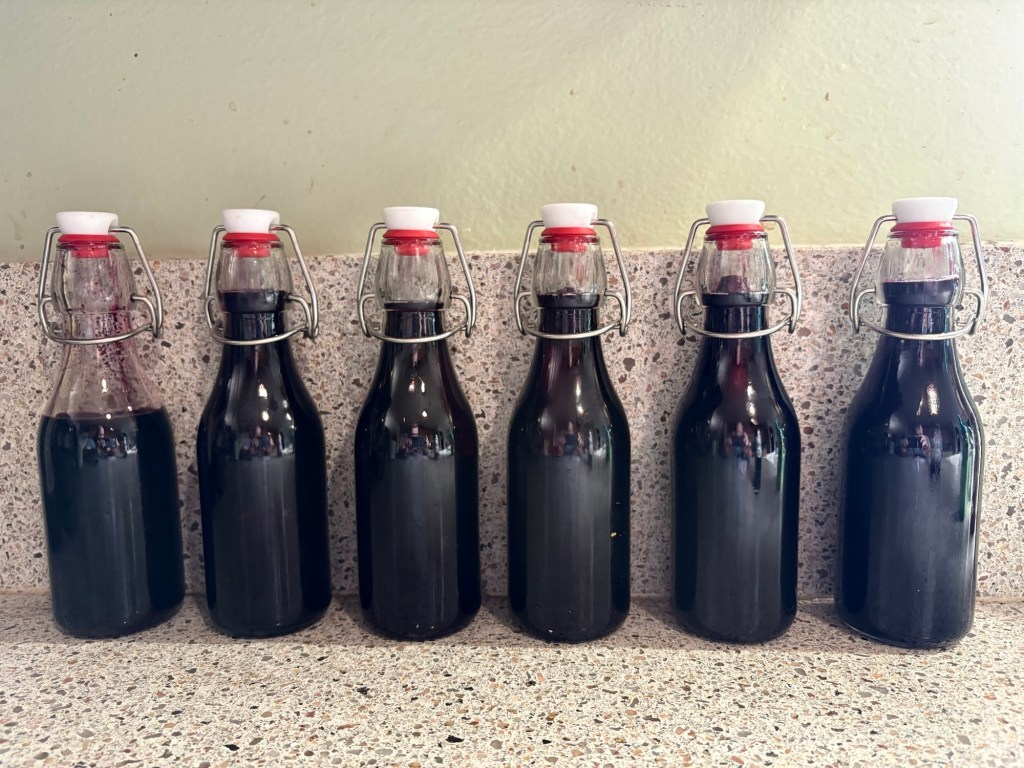
We made a half gallon of syrup, boiled with honey, ginger, cinnamon and cloves, and another half gallon of cordial, which contains vodka.
Then later in the week we made another half gallon of syrup to distribute out to friends.
The elderberries keep coming in, and juicing, while efficient for processing, is not ideal for storage because it cannot be canned. So we have opted for drying the rest.

The girls pick the drupes off the cymes in the afternoon when we return from the farm, usually listening to a Redwall book on Audible. They load them onto the dehydrator.
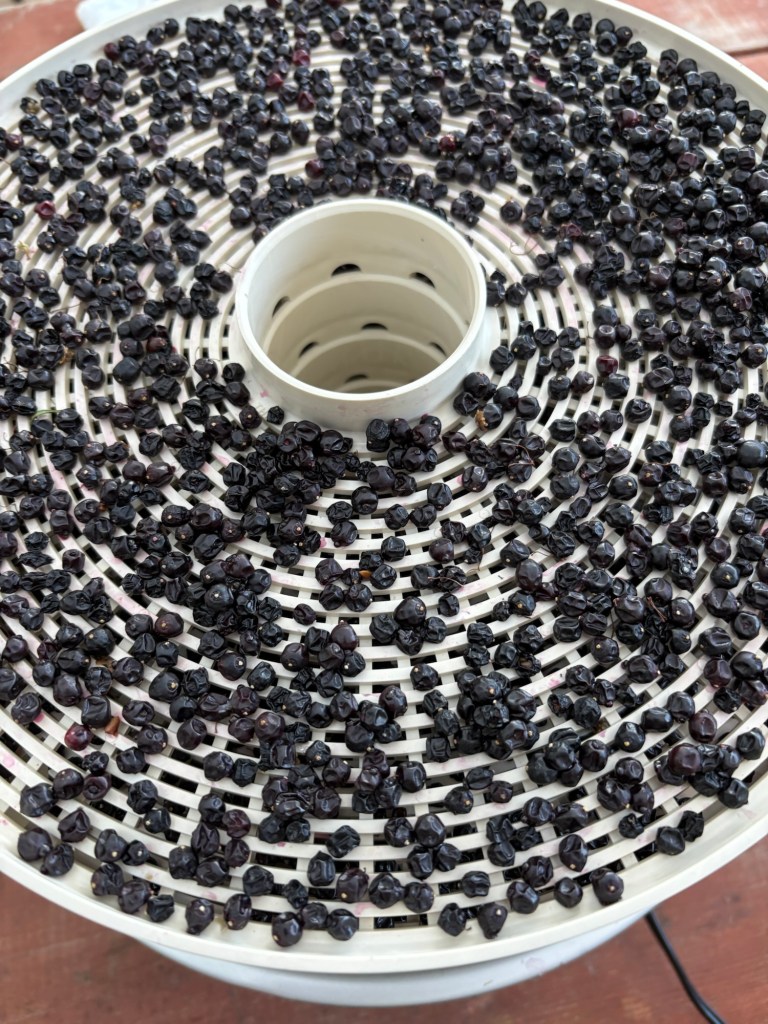
12 hours later.

36 hours later.
These dehydrated berries are much more shelf stable and can be used in very small amounts, such as tossing a tablespoon into a mug and steeping elderberry tea. It is important to note, however, that these dehydrated berries are not technically cooked.
More where that came from. We have lots more experimenting to do.

 Little Farm in the Big City