All Farming Starts with Stewardship of the Soil.
As Dorothy Sayers put it in her essay “Why Work?” “We have had to learn the bitter lesson that in all the world there are only two sources of real wealth: the fruit of the earth and the labor of men;”
In all the world there are only
Dorothy Sayers
two sources of real wealth: the fruit of the earth and the labor of men;
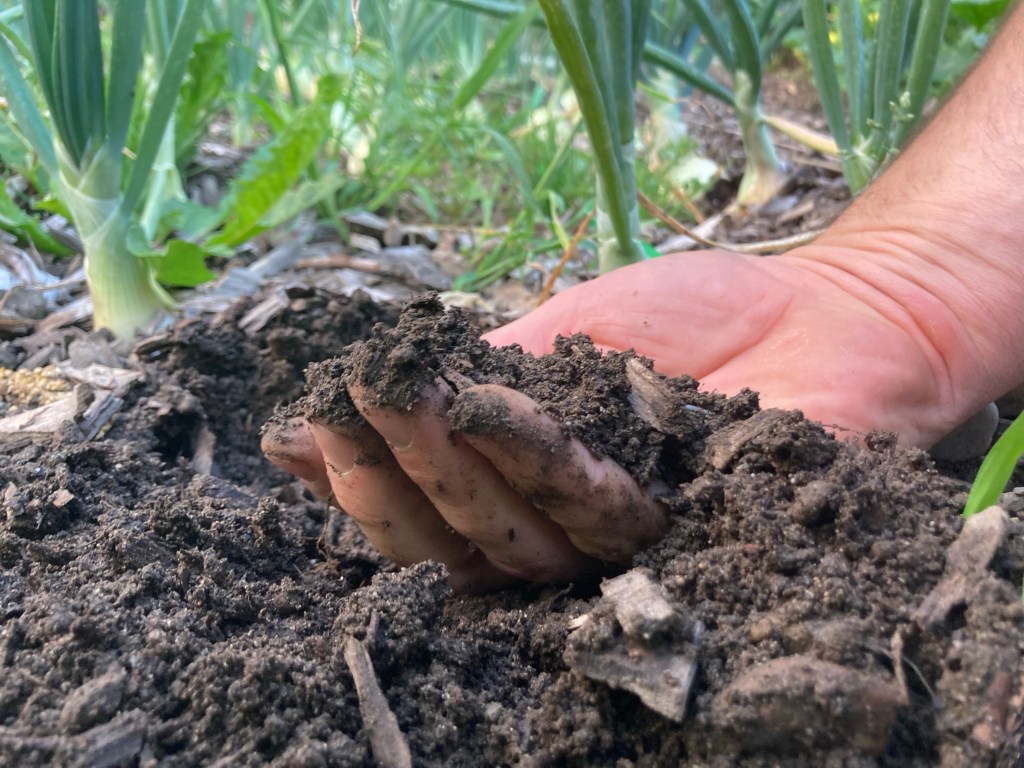
Most people, I suppose, do not consider that for all the plants and animals above the ground on a farm, there is far more life and activity going on below the ground. The biological web really needs only a few major inputs: sunlight, carbon, nitrogen, water and other elements in increasingly smaller amounts. While we mostly think about these things coming from above the soil, and that is true, most people do not realize that most of the processing of these resources takes place below the soil.
Water, for instance: While many plants do have the ability to absorb water out of the air, most of the water that plants uptake comes from their roots.
While all plants need nitrogen to grow, and nitrogen is the most abundant element in the atmosphere, plants do not have the ability to take nitrogen from the atmosphere. This has to be done by bacteria that absorb atmospheric nitrogen and fix it into forms that the plants can use.
The same is true of phosphorous and potassium from rocks. Organic acids in the soil, produced by microbes and other organisms from the breakdown of organic materials, dissolve rocks over time and release the minerals in them, which are taken up by still other life-forms, and then eaten by other life forms, and eventually secreted in a form that plants can uptake.
Virtually all trace minerals required by plants, animals and humans must be processed by a long chain, or better yet a vast interlocking web, of lifeforms under the soil.
Modern farming techniques often show a shocking disregard for that reality. We tend to treat the soil as if it were merely a sterile grow medium, a sort of container for holding seed and fertilizer, and we get upset when it insists upon having extra living things in any given plot other than the mono-crop we want to see.
If history demonstrates anything, it is the principle that reality is the sort of thing that can be disregarded with impunity for only so long. Eventually there are repercussions. The consequences of monoculture have been the loss of topsoil, the increased use of artificial fertilizers, the increased use of pesticides, herbicides, and fungicides, increased surface water run-off, decreased soil reservoir and aquifer water… the list goes on.
It turns out that nature is not a factory. When we treat it like one, it breaks.
And for all this, nature is never spent;
There lives the dearest freshness deep down things;
G. M. Hopkins
We believe that the solution is a return to the soil, not just for a tiny percentage of the population who are professional farmers who make a living producing food for everyone else, but for everyone to one extent or another. For some this may mean a compost bucket or worm farm under the sink, and a tomato-basil-marigold guild in a pot on the balcony. For others this may mean a 3000 acre ranch intensively managed with sheep and cow leader/follower mob grazing.
For us, we have 900 square foot home garden/orchard plot that we have been gradually improving since 2015, and we have a 3 acre homestead that we started working in 2022.
The size of the plot matters very little, if managed with attention and respect for what it is and the nature of things. What matters is that everyone get their hands in the dirt, learning to feed the living web in the soil, and watch the soil produce abundantly according to its nature.
So we are embarking on a project to steward our soil with a multipronged approach.
- Organic matter: The first winter after we bought the farm we got loads of free wood chips from Chip Drop and spread them all over the garden.
- Manure: First from chickens, then from geese (pig manure isn’t great as fertilizer, it has to be aged first, though even that will eventually make its way into the garden and orchard) and eventually from cows, sheep, ducks, etc.
- Worms: Our worm bin is one of our most successful enterprises. It allows us to turn bags of shredded paper and kitchen scraps into gallons upon gallons of worm castings which we use to top dress the gardens, and will continue to use through the fall and winter to build the deep beds in next year’s gardens.
We invite you to come along and join us as we seek to build the diversity and productivity of our soil over the next few years.
Wheelbarrow PT
Sometimes you have to choose between farm work and training. Or do you? This week I have been doing “wheelbarrow PT” in the mornings. We are running out of time to plant our winter garden this year. Some of the crops with longer days to maturity (DTM) need to be well established and growing by…

Back to the Worms
Last week we worked on harvesting our latest round of worm castings. Part of that process is filling our new bin with worms and fresh worm food. This time we pulled the ashes and charred wood out of the fire pit to be part of the next batch of worm composting. This is referred to…
 Little Farm in the Big City