

Yesterday was day 17 of the hard cider experiment.
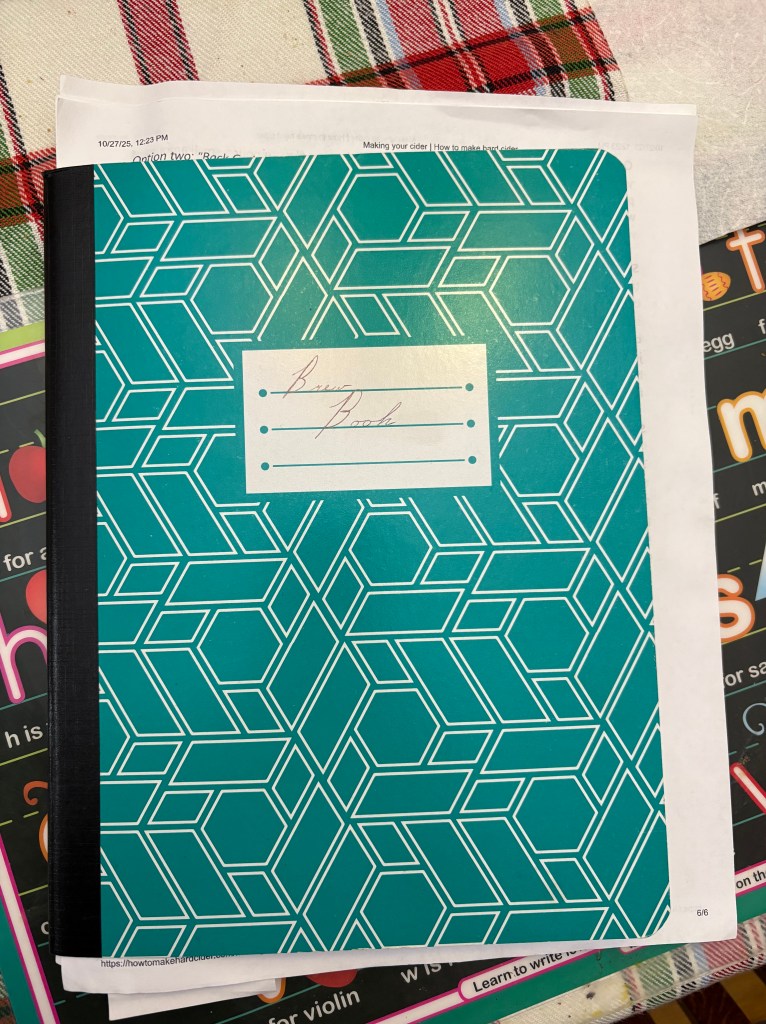
According to the “Brew Book.” Which is gleen, in fact, not brue, but it works.
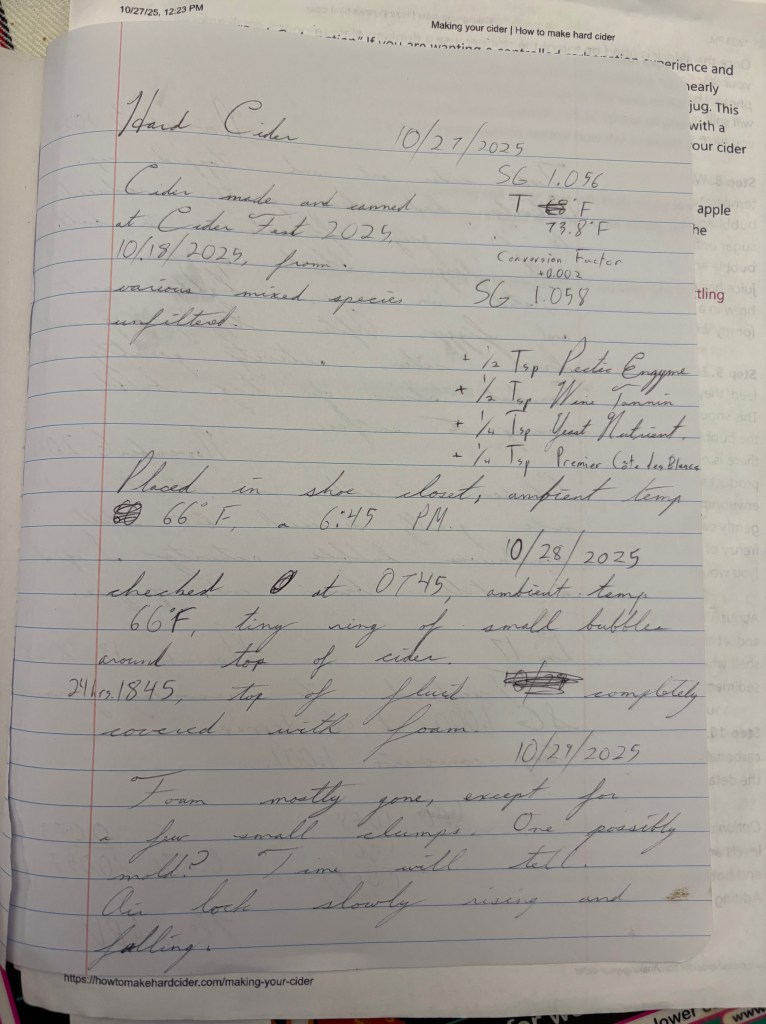
I have been keeping meticulous notes in an old school note book.
On the way back south after a National Guard day (long story) I stopped by our local home brew store and chatted with the owner for half-an-hour or so, learning what I could about hard cider brewing process. It turns out I have been doing it mostly right, and getting the rest right by accident. Among other things I learned that it is not recommended to let the cider “sit on the lees” for more than two weeks. That is, once the debris starts forming in the bottom of the jug (primarily the bodies of dead yeast cells), he recommends moving it to secondary fermentation to continue aging and to ferment out all the sugar.
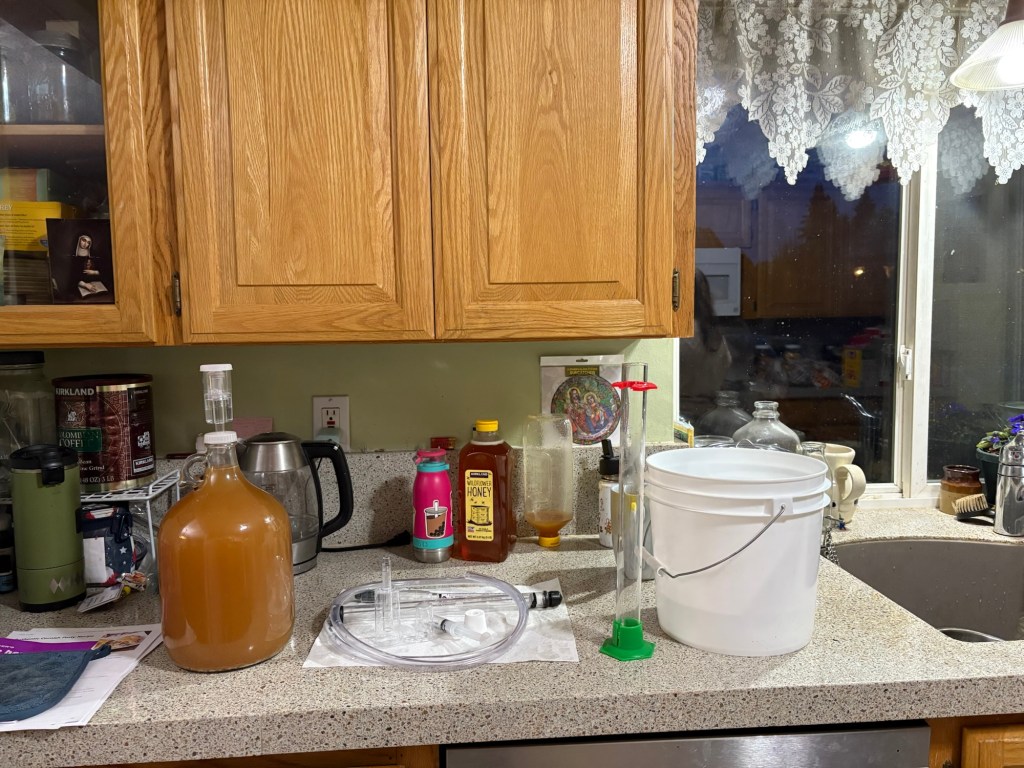
So after getting home, that is what we did. The first step was, once again, sanitizing all the equipment.

Then figuring out how to use the siphon starter.
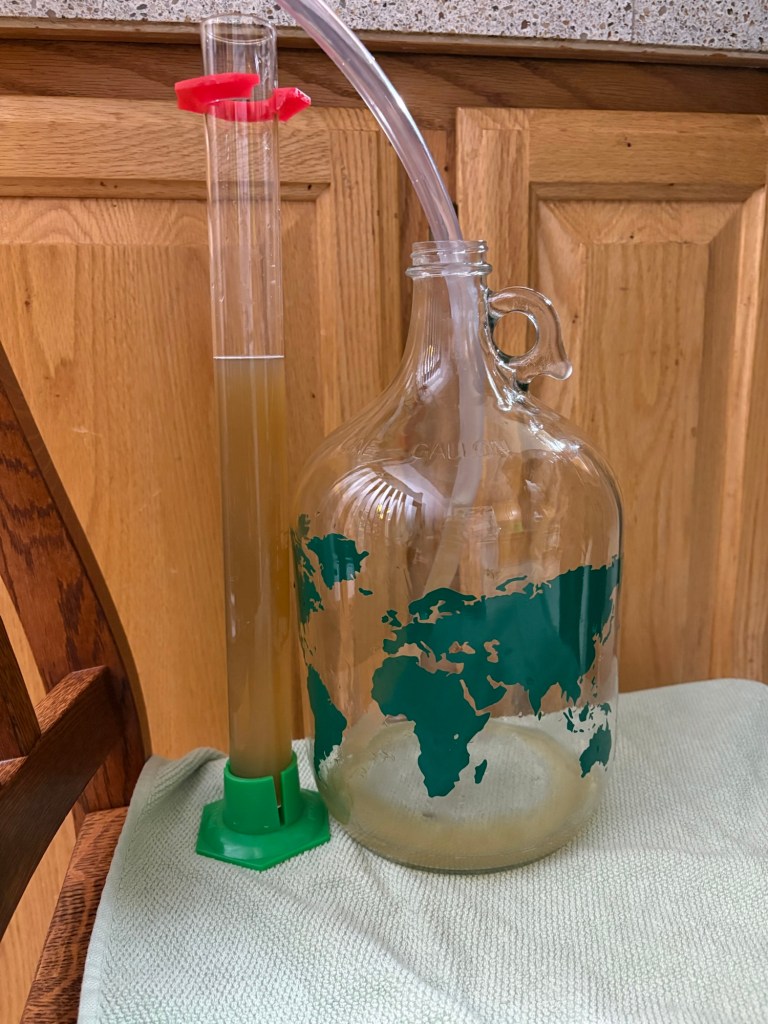
The first bit we siphoned off went into a cylinder so we can check the Specific Gravity. This gives us a window into how much sugar is left to ferment, and what the alcohol content is.

Then we siphoned the rest into a one-gallon glass jug. This is going to be the secondary fermentation chamber.

Keeping the siphon running was more challenging than expected. It looked to us like it kept bleeding CO2 up into the tube which displaced some of the liquid, which would periodically stop the flow and we would have to use the pump to get it going again. This was discouraging because at this point we want to avoid introducing oxygen into the mix as much as possible, as the presence of oxygen will promote acetifying (vinegar forming) bacteria.

We read the hydrometer at 1.000, at a temp of 66 degrees. Using the temperature conversion factor, this works out to an actual SG of 1.001.
Initial SG was 1.058. Second reading after 17 days is 1.001, yielding a delta of 0.057. The calculation for eABV (estimated Alcohol by Volume) is (SG1-SG2)/0.776.

The result is roughly 7.3% eABV.
We tasted some of the deep cider left sitting on the lees. It was thick, cloudy, almost chewy, with a vaguely sourdough after taste. By contrast the cider pulled off the lees into second fermentation was much clearer, sharp and dry. Tasty and drinkable, but not particularly exciting.
This cider was put back into the closet with an airlock. Now to watch it for the next two months to let it mature.
Tune in sometime in the new year for the exciting conclusion of season one of “Hardening the Cider.”

 Little Farm in the Big City