

Meishans are a very interesting species of pig. We haven’t completely figured out their behavior yet. Most of the time you can run them through the pasture and they may root a little here and there, but overall they will leave it alone. At most you’ll have a spot or two where you have to kick the sod back in place, toss down some grass seed, and call it good.
Of course, if you leave them in one spot for a week or two, that will not be the case. They will root the entire area eventually. However, they don’t usually root as deeply as other breeds of pigs (duroc and hampshire) that I have seen.
But then we put them in this one paddock for only one day, and they roto-tilled almost the entire thing. The next day they didn’t even touch the the next paddock.
I am not sure why. Perhaps there was a higher population of grubs or worms, or a kind of plant that they like. Maybe they were bored. Who knows.
Regardless, that means we need to repair the paddock.

There are a couple of principles here that I find helpful to keep in mind.

- Herbivores go first. Always make sure the ruminants have the first pick of the paddock. This is because they can actually eat the grass and benefit from it, while the pigs don’t really gain much from roughage. Also, the ruminant manure is pasture gold, and you want the pigs to scatter it around as much as possible.
- Limit disturbance to a day, or two at the most, whenever possible. A brief burst of soil disturbance can release nitrogen and aerate the top couple of inches, which promotes a burst of new growth. Multiple days of disturbance will kill off that new growth and burn up that nitrogen.
- Replace the carbon. Every time you mix oxygen into the soil it bonds with carbon to combust (the same reaction that takes place in a fire, only much smaller scale) and some of that carbon floats off as CO2. So whenever the soil is disturbed, you must add organic matter. This is part of the reason we are feeding so much hay on pasture. We could probably feed less, and force the sheep and cows to be less picky, but every straw that they don’t eat because it is coarse or low quality, is a straw that gets stomped or rooted into the soil to feed the carbon chain.
- Tip the seed-balance in your favor. One of the effects of selective pruning is that (up to a point) the plant that gets pruned is stimulated to grow more than than the plant that doesn’t get pruned. This means that if the cows and sheep routinely prune their favorite food, given enough recovery time, and enough carbohydrate reserves, they will (ideally) over time, outperform the species they find less tasty. We can help this along by selectively weeding out the tansy ragwort and curly dock and other less palatable species. However, if the pigs have rooted up the sod and disturbed roots of the grass, we now have an opportunity for new seeds to take off, and these could be grass seeds or weed seeds. So wherever the pigs have rooted, we spread pasture mix seeds to tip the balance of species in favor of forage species.
- Always cover the soil. The pigs like to push all the hay the cows and sheep leave behind into a pile and use that as their nest to sleep in, so we have to go through with a pitch fork and toss if back over any bare spots in the paddock. This prevents the rain (in the winter) and sun (in the summer) from hitting bare soil and eroding or baking it to death.

6. Wear your boots. Not your Toms.
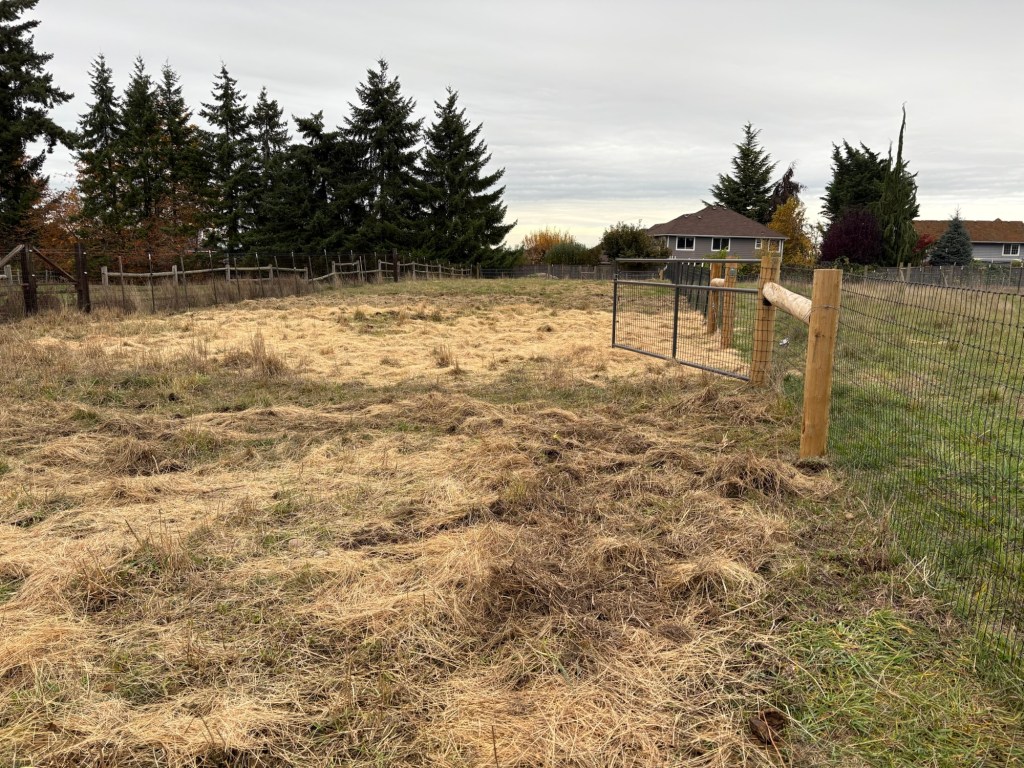
So there we have a newly repaired paddock, resting until spring.

 Little Farm in the Big City