

Tuesday, 9/30/2025
We pulled the sauerkraut that has been fermenting in the basement for the last 19 days. The temperature in the basement is cooling down as the weather outside cools. It is now about 64 degrees ambient temperature.

The jar on the right is a special case. This was a jar of red cabbage sauerkraut that we kept in the kimchi fridge for over a month before fermenting. The temp in the kimchi fridge was 31 degrees F. You would think this might freeze the cabbage, but it did not because of the high salinity (3%). This was then moved into the fermenting chamber 21 days ago.
As with the previous batch of red cabbage sauerkraut, I think I over-packed the jar. Initially it was full of brine, but a good deal of that bubbled out as CO2 (presumably) built up underneath it and forced the fluid upwards leaving large air pockets deep in the jar. Essentially, the tightly packed cabbage leaves behaved like a one way valve, forcing the brine out.
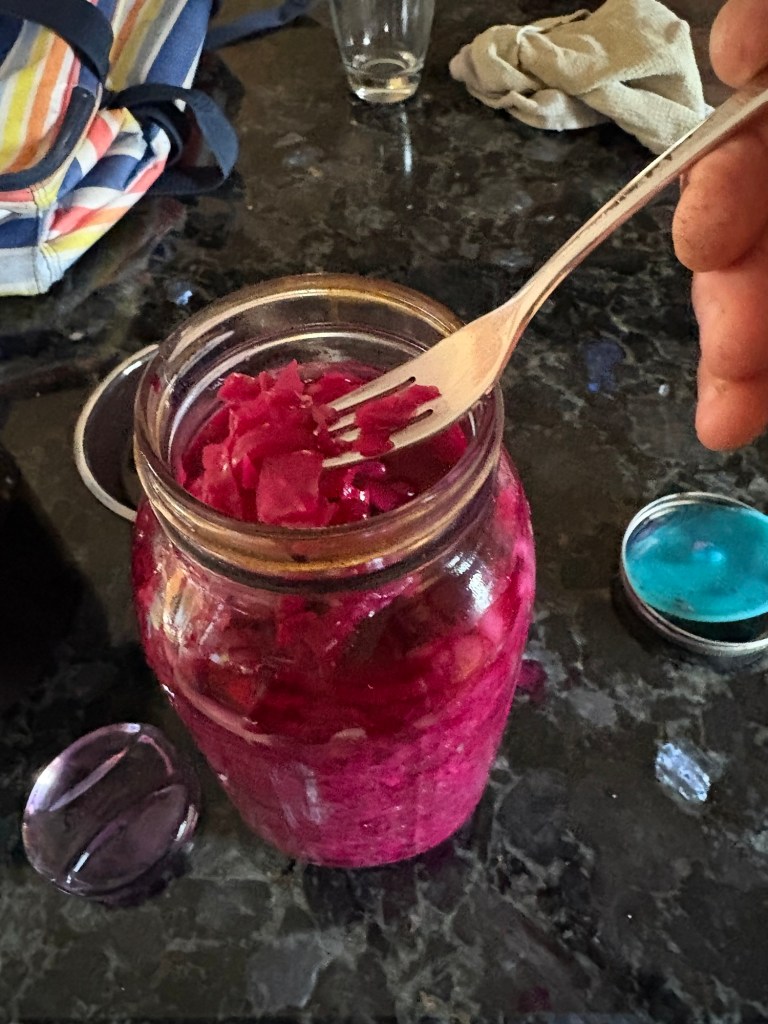
This is a very mild flavored kraut, more tender than its predecessors. Perhaps the longer salting time in the kimchi fridge helped with that. It is not very acidic, the “sauer” flavor is lacking compared to its predecessors, but I don’t dare let if ferment longer without a protective brine layer, so it will go into the fridge and be eaten over the next week or so.
Notable that this was the cleanest batch so far. The jar had zero growth on the top, no mold or yeast formation whatsoever. Perhaps I will trial another batch in the kimchi fridge and see what happens.
The crock and the jar of green cabbage kimchi, on the other hand, both had the rubbery SCOBY-like growth on top. These are not likely an actual SCOBY. SCOBY (Symbiotic colony of bacteria and yeasts) forms in kombucha where it can feed off the sugar and tannin found in tea. It would not be able to survive in the saline environment of sauerkraut brine.

Instead, this is most likely a growth of kahm yeast. It is beige/off-white, with a powdery upper surface, and it sits only on the surface of the brine without growth or extension into the fluid.
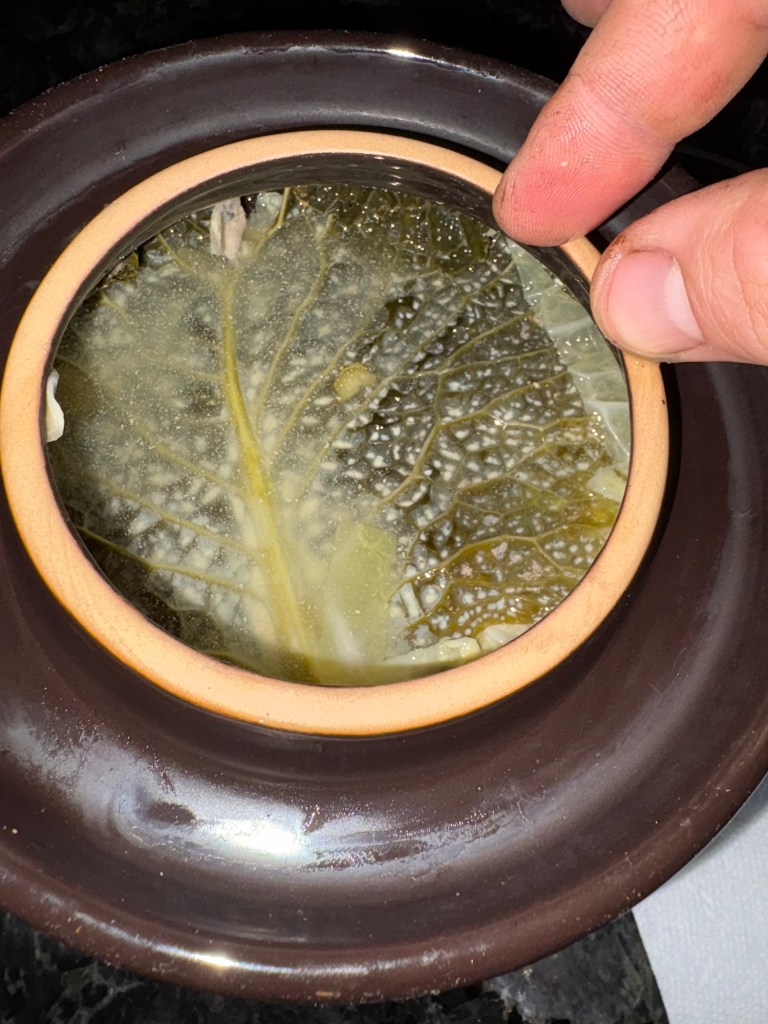
Underneath is clear brine, and below that one of the isolation leaves.
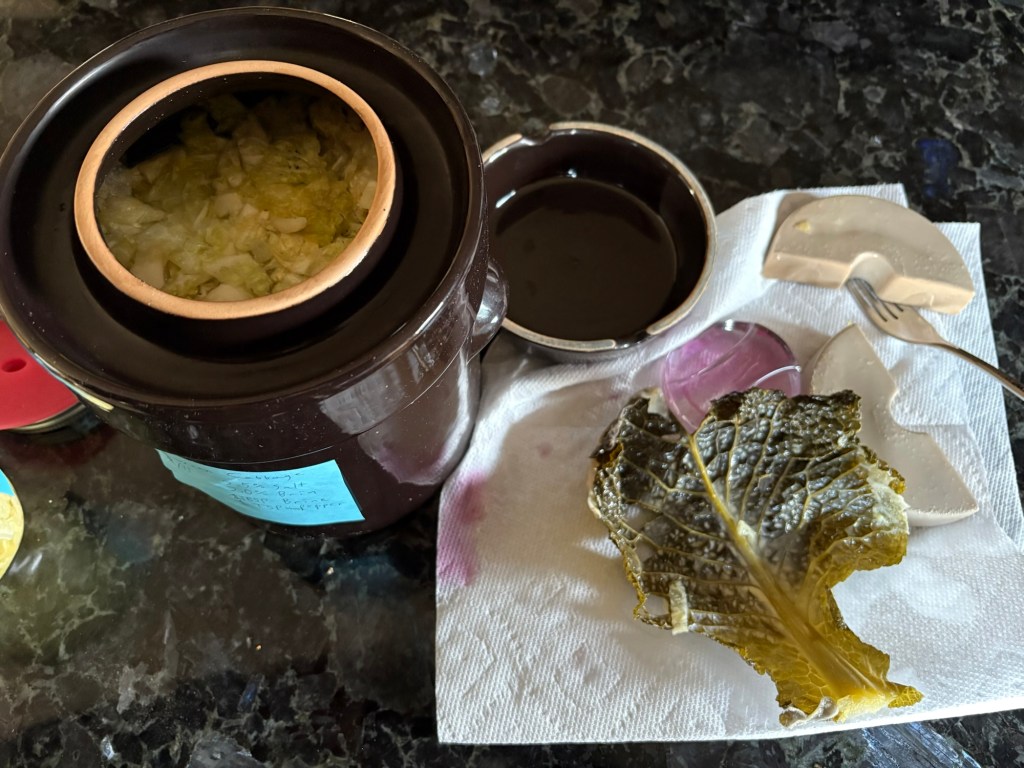
When the isolation leaves are removed, they are clean and mold free, and underneath is a pleasant smelling batch of sauerkraut.

With a crisp, crinkly texture and mild flavor.
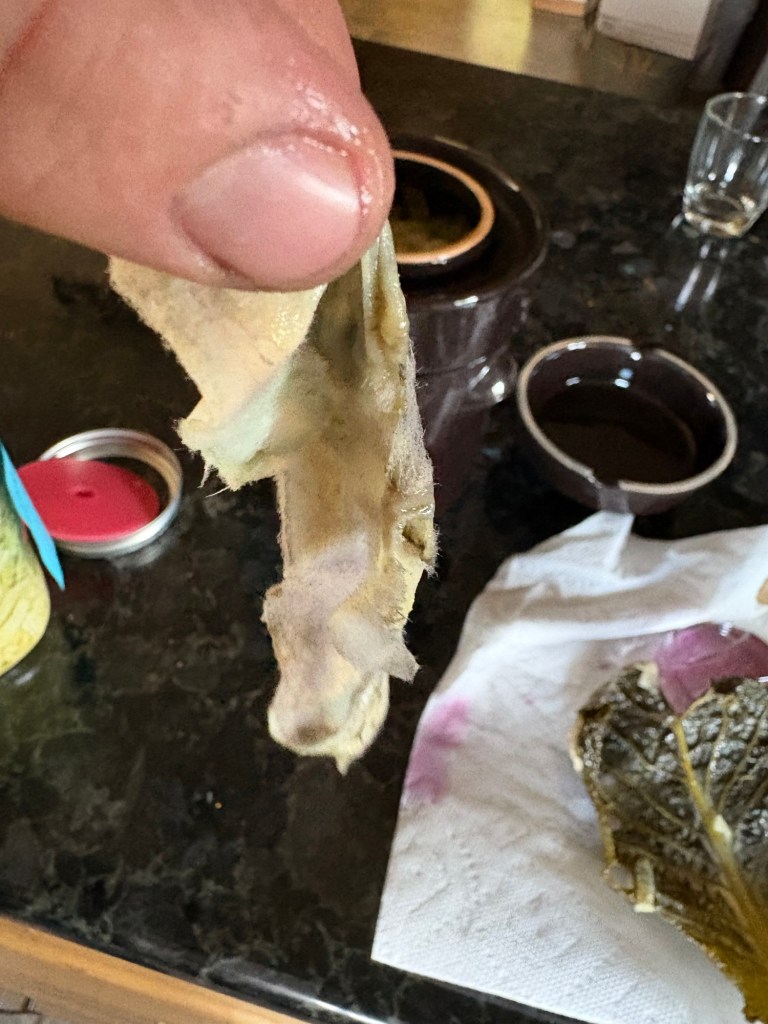
Close up of the kahm yeast.

Nothing under the surface of the brine, or underside of the weight, or on the isolation leaf.

The green stuff in the cabbage is dill weed.

Which definitely enhances the experience of this batch of kraut.

 Little Farm in the Big City