

Two weeks ago we made sauerkraut.
Since then, we have been having… learning experiences.
The kimchi fridge wants to store the ferments, not ferment them. To keep it at a fermenting temperature I would have to check on it every day, which we just don’t have time to do.
The temperature in the basement is holding steady at 68-69, just below 70. We’ll see how that changes in the next few days of 90 degree temps outside. It is technically cool enough to ferment, but the risk of mold is higher. As it turned out, that is exactly what happened.

The water seal on the crock evaporated, and on looking in the top leaf of the kraut was exposed, not covered with brine. The beans are a total disaster. The mold is actually on the silicone burp lids as well, which might be a bigger scale problem. They went to the compost.
The cabbage had mold floating on the top of the brine, which I pulled off, as well as the top bit of brine. Underneath that was the glass weight and the top cabbage leaves keeping the shredded cabbage in the brine. I pulled those out and gave the cabbage the old sniff test. It didn’t smell rotten. It just smelled like sauerkraut, so I tasted a forkful that night, and sealed the jar and put it in the fridge, and sat back to wait for any dire ill effects.
Nothing happened.
Then the next day I ate another forkful. Still no gastrointestinal consequences.
Didn’t eat any on Wednesday, but on Thursday I ate a good bit raw, and then fried more in my omelet. Mommy tasted some, and so did Winnie and Seppi.

It is very crisp and crunchy, almost with the same crunch as raw cabbage, but with a pleasant level of acidity, and still a good deal of the cabbage sweetness. It could probably have stood another couple of days, but with the mold starting to form we had to end it when we did.
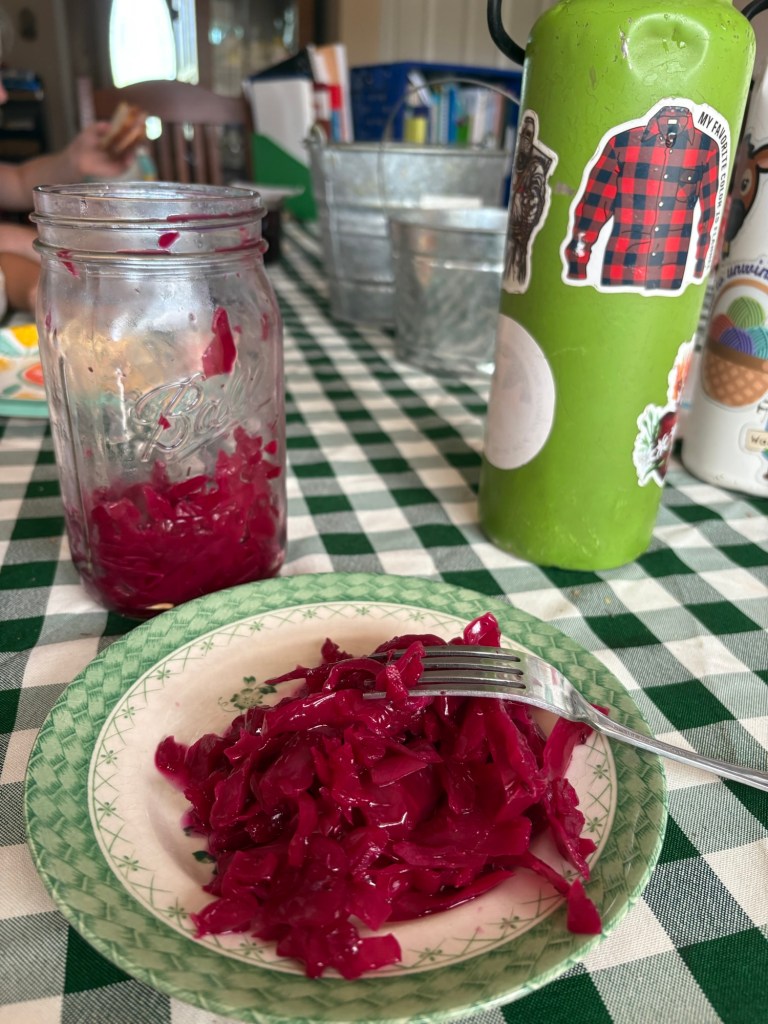
Finished the last of it on Saturday. A quart didn’t last long.
So, lessons learned:
- Fermenting at higher temperatures requires higher salinity to prevent mold. Next time we will try 2.5% or 3% rather than 2%.
- The water seal crock requires closer observation than the silicone lids. The water that forms the seal can evaporate in a few days.
- The silicone lids might be a problem. After this happened we ran them through the dishwasher and set them on the table, but after two days they had mildew forming on them. I need to do more research and see if they can become contaminated with mold in such a way that they have mold in the pores or something? I had always thought silicone was a non-porous substance.
- Mommy thinks the sauerkraut needs more flavors. She is thinking nutmeg.
We have two more red cabbage heads in the garden, and a dozen or so green cabbages. We will see what we do with them.

 Little Farm in the Big City