

With the three lamb legs we did not freeze, we are trying an experiment.
Lamb prosciutto.
After several hours of internet research, we settled on a method and two recipes to try.

- Recipe 1
- 120g plain salt
- 14g ground pepper
- 6g sweet paprika
- 6g hot paprika
- 12g thyme
- 8g rosemary
- 3g fennel seeds
- 12g brown sugar
- 10g ground nutmeg
- 10 garlic cloves
- 6 bay leaves
- Red wine
This recipe has a ratio of approximately 56g of salt per 100g of mix (before the garlic gloves and red wine).
- Recipe 2
- 120g salt
- 8g black pepper
- 24g Sugar
- 12g crushed mint
- 12g garlic powder
- 12g tumeric
- 12g paprika.
This recipe has approximately 60g of salt per 100g of mix. I also tend to think it’s a bit heavy on the turmeric, but that may just be because I don’t like tumeric.

While the rest of the spices can be added by volume if you wish, the salt must be weighed out, because for food safety reasons the salt must have 3% of the mass of the meat. We opted out of the nitrites/nitrates, because there is some controversy over their health safety in large quantities. The downside is that nitrites allow a slightly lower percentage by mass of salt, so our end product may end up being saltier than we like.

Three legs, three experiments.

Again, from everything I’ve read, the key to preventing spoilage is adequate salt. 3% seems to be the bare minimum.

Leg 1: 2098g. 3% = 62g salt, so 110g of mix. I added 120g of wine (heavy hand) and this made it too sloppy, so added another 50g of mix. This brought it up to almost 6% mass, but I was still amazed at how thin the coating was, especially after making sure every nook and crevice of the end of the leg and the ball joint were coated. Other people use the “salt box dredge” method which just means coat it until there is no exposed flesh.
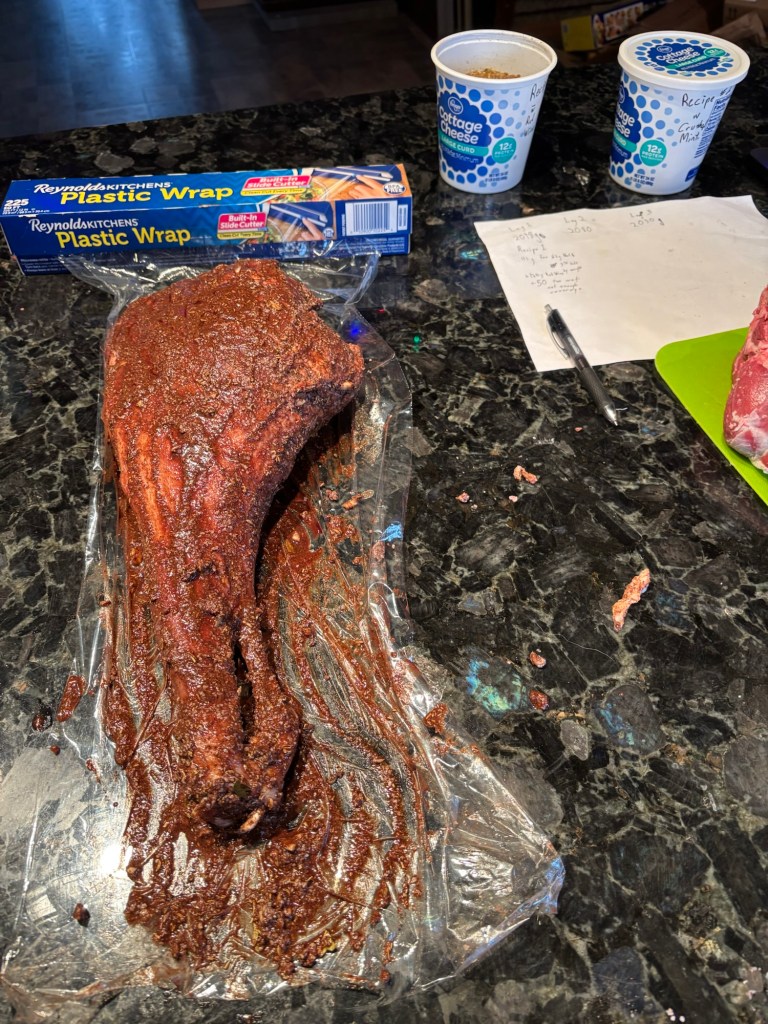
All in all, not a bad looking leg.

Leg #2 2080g. This recipe called for 5% total salt between two rubs, so I measured out 105g of mix for 52g of salt.
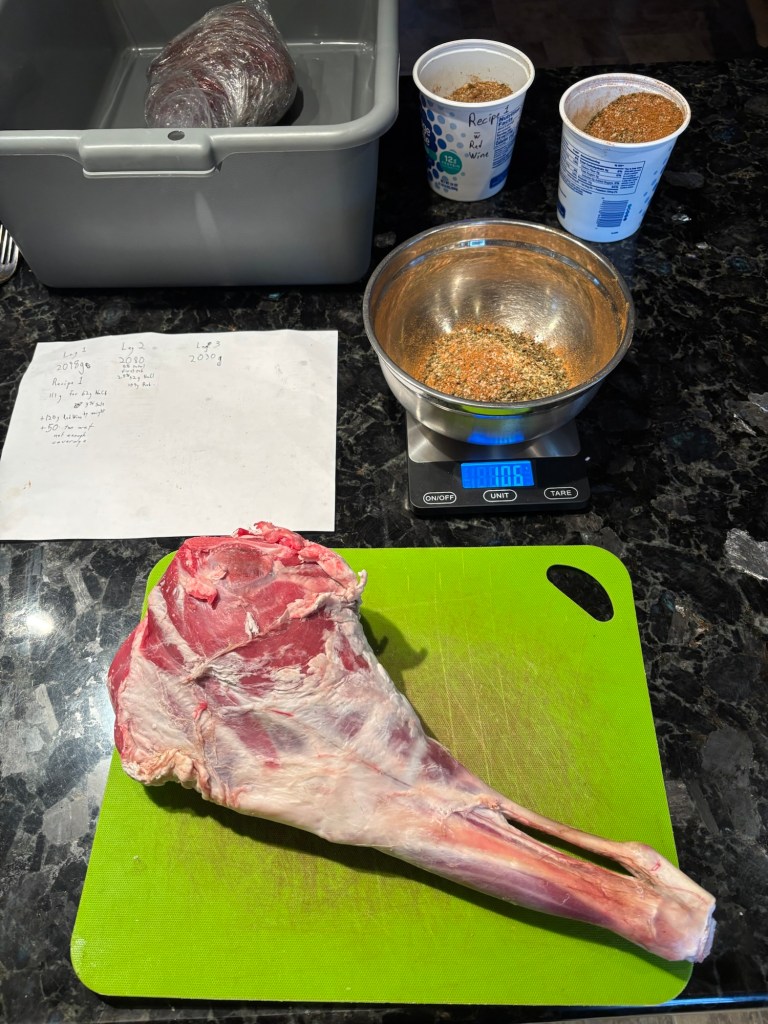
You will notice we did not trim the fat, which is a bold move. Fat can turn rancid more easily than the meat can spoil. I plan on coating the entire leg in lard before aging it, to keep the air of the fat so it does not develop a hard shell.
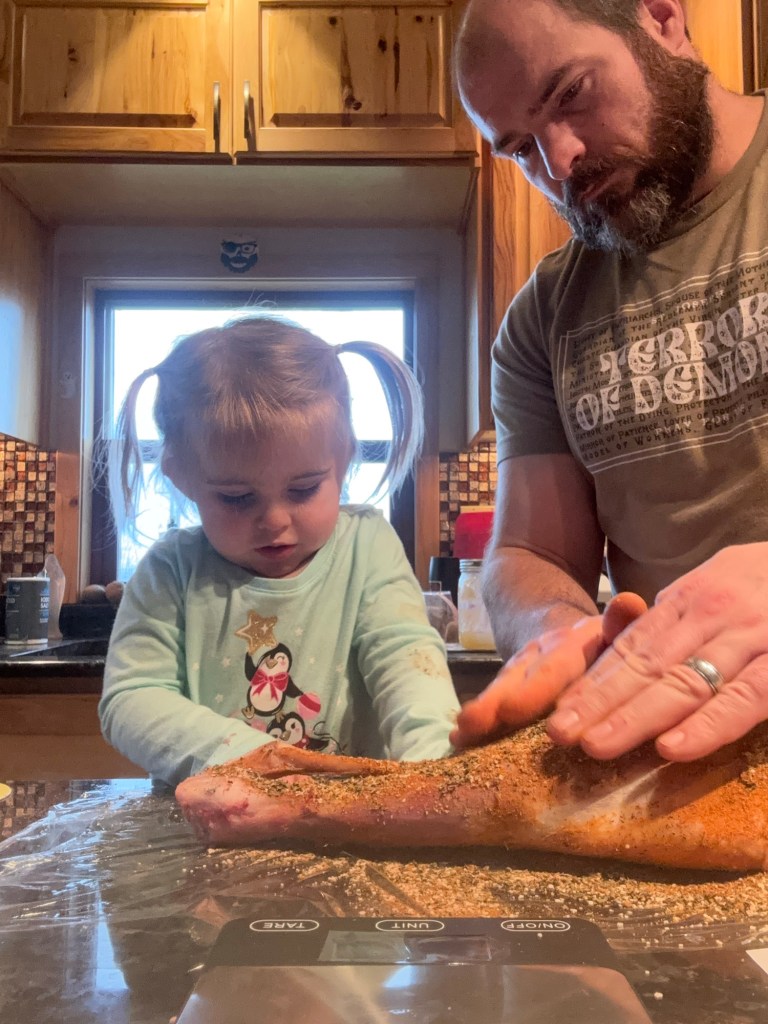
Again, 2.5% seemed to me a pretty scanty coating, but since I am a learner, I am going to trust the recipe and see what happens. Worst case, we lose that leg.

Leg 3: 2030g. 3% mass = 61g of salt. This time we are dividing the 3% between two rubs to see if: 1) the meat will spoil; 2) leg 3 will be noticeably less salty than leg 1.

Ready for the fridge.
Now for the most counter-intuitive part for me. All the dry curing I have read about before rely on the salt pulling fluid out of the meat, meaning the meat is generally on a rack so that the fluid falls into a tub under the meat. The prosciutto procedures I read, however, called for wrapping the meat as tightly as possible in plastic (some of them vacuum packed it) to keep the fluid against the meat. This is removed after a week, and the meat is washed thoroughly in clean water (or red wine for Recipe 1), and then recoated, re-wrapped, and allowed to sit for another week. Only then is it prepped for actual dry curing.
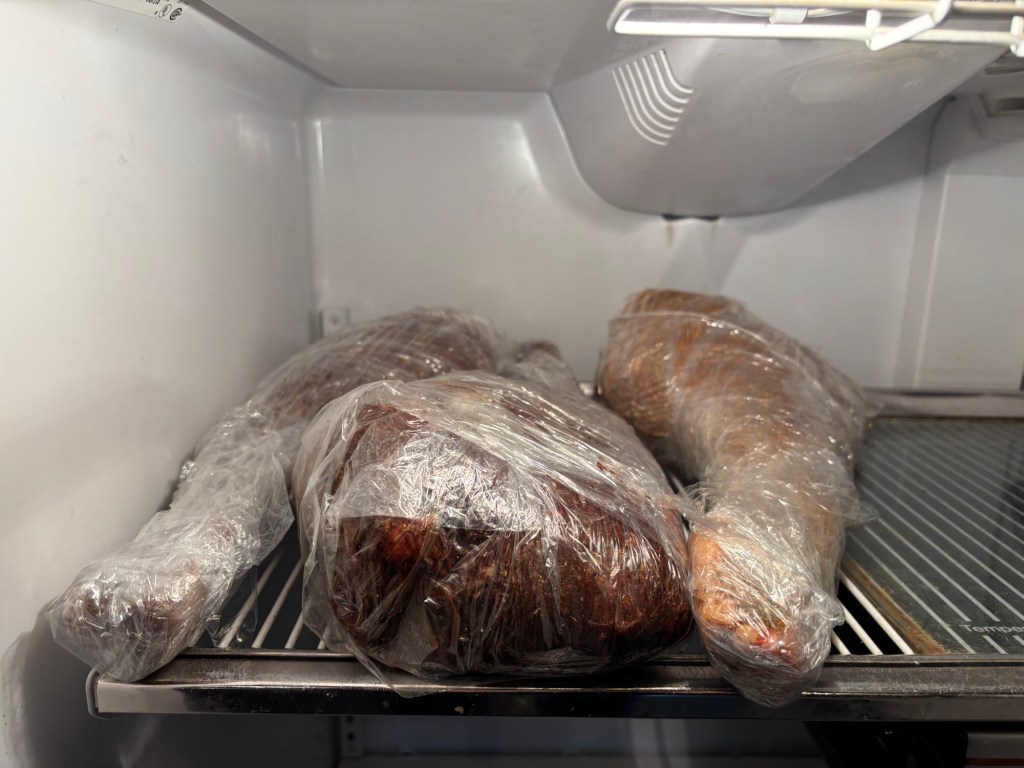
I am not sure what the meat will look like (and smell like) after two weeks soaking in its own juices in the fridge.
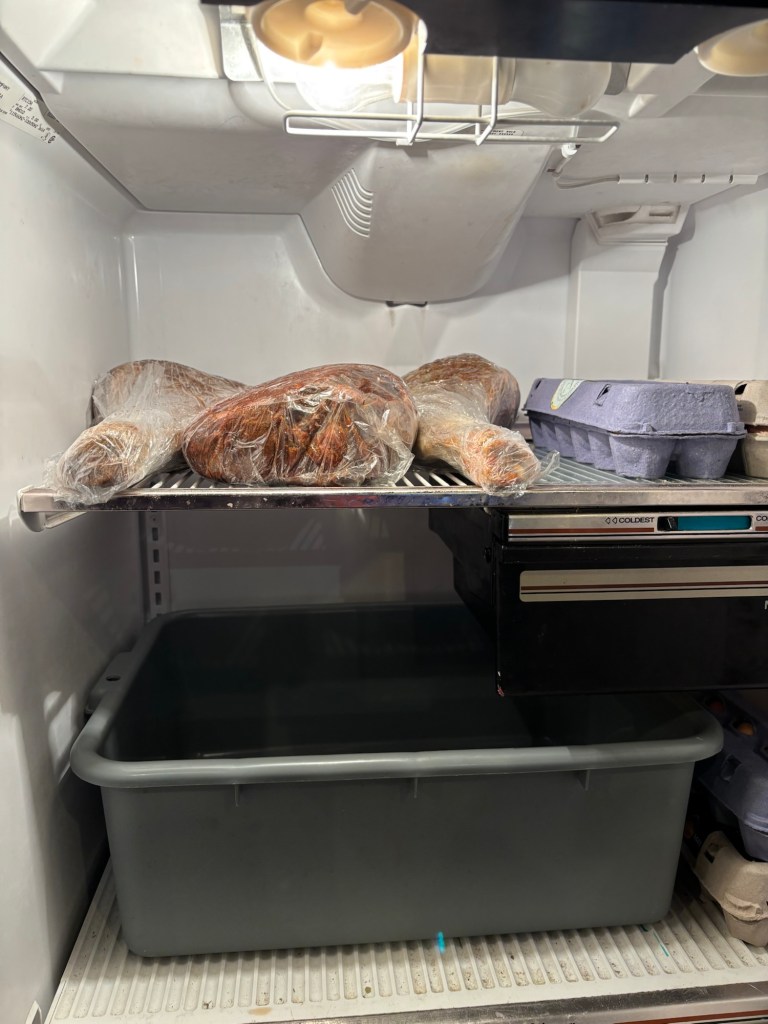
On day 3 I had to put a tub under the meat to catch the occasional spare drip.

 Little Farm in the Big City
2 thoughts on “Lamb Prosciutto”