

Monday, Dec 30 the stars aligned. The weather was forecast to be 40 degrees during the day, and almost freezing overnight, and below 40 into Tuesday as well. Not only that but Ryan and Adam both had the day off. The time was right. The sheep must die.
To recap, They were a pair of 10-month-old whethers, born on February 14, 2024, purchased on April 14, 2024, kept on grass and hay until now. No grain. We did buy them one bag of sheep salt, which is about 70% gone.
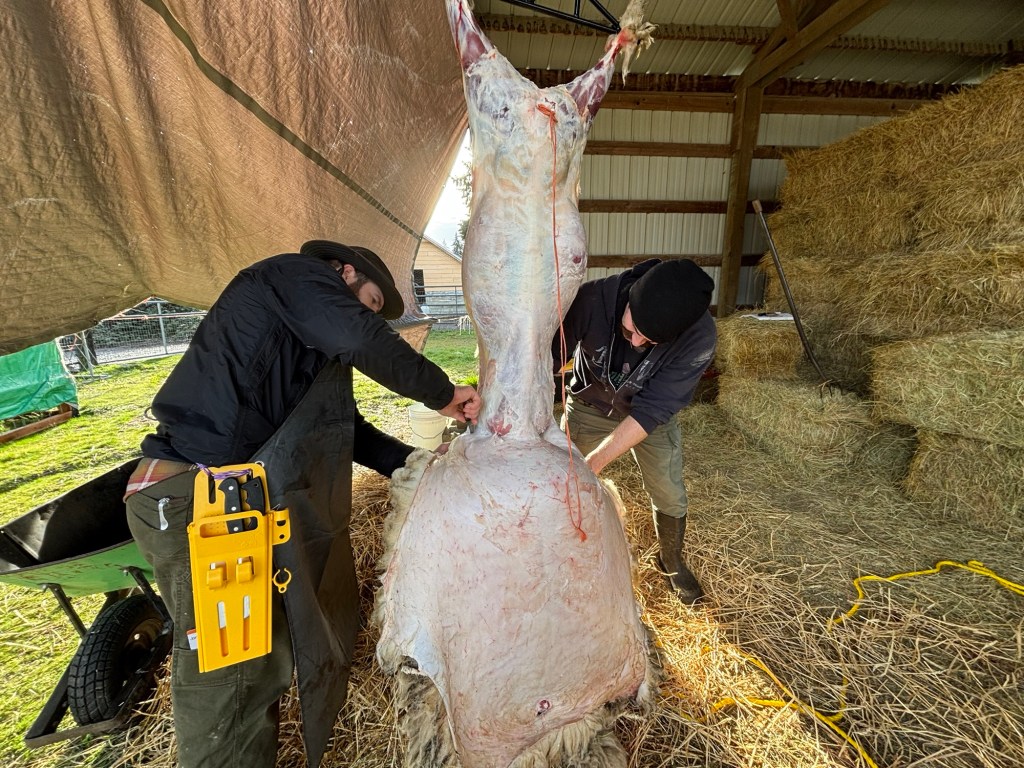


And there they are, hanging out and chilling overnight in the shop.
Lessons learned.
- As with many things on this farm, we need to be better about our record keeping. I can tell you both sheep cost $250 dollars together. We don’t know how much they weighed at purchase. I know we bought castrating equipment and salt, but without digging through a hundred old receipts I couldn’t tell you how much they cost. We don’t know how much hay they have eaten, only how much hay we bought total and how much has been consumed (and trampled) so far between them and the steers. Most glaring of all, we don’t know their final live weight, or final hanging weight. That was simply an oversight. We do have a game scale (I use it for weighing my rucksack), we could have hung each one up from it and gotten a quick weight. We just didn’t think about it. So we do not have a final cost per pound.
- We need to sit down once a week and log receipts, itemizing them by project.
- We need to put the game scale in the box of slaughter equipment.
- Slaughter was challenging because we don’t have a confinement stall. The first sheep was happily munching a treat when I shot him, and he dropped like a rock. The second sheep then refused to come near, no matter what treats were offered, and I had to drop him at a distance of about 12 feet with a 9mm pistol. I am pretty accurate and dropped him successfully, but even an inch of variation is very possible at that distance, and can result in less than a clean kill. Also wasted a lot of time
- Install a fold-out gate on the pen so that the sheep can be confined and ideally pinned still between a gate and a panel.
- Have the actual slaughter area out of sight, sound and smell of the barnyard.
- The gambrel with the block and tackle was worth every penny, as was having a dedicated box for butchering. Made set up and cleanup much faster, and allowed us to work up off the ground.
- Rope on the gambrel is the cheapest nylon twist money can buy and got slippery when it got blood on it. Need better rope. It will not be adequate for the steers.
- The rafter we hung it from will never support the steers. Need a better work area/hang point, preferably one that we can back a pickup truck under. To get the necessary height clearance for that may require some timber framing.
- We hung the carcasses in the shop to cool. This forced us to wait for a day/night cool enough. Sheep benefit from at least a 12-18 hour hang, but 3-5 days in temperature control is even better. However, we are at the mercy of the weather unless we buy, build or go-in-on a walk in cooler. This is a huge undertaking, several thousand dollars, so not on the front burner right now. Not even on the stove. Even if we do slaughter on site, we will continue to send out larger animals to our local butcher for processing.
That’s all the thoughts on the slaughter. We will be back tomorrow(?) with thoughts on the butchering/packaging.

 Little Farm in the Big City