

Despite being a little under the weather yesterday, we processed this year’s buckwheat, mostly. I would say 90% solution. I also have to say, this year it has been night and day, less labor intensive and more efficient than last year.
This year we hand harvested into a garbage pail so we had much less contamination in the seed. We only planted about 210 square feet of buckwheat this year, compare to nearly 2100 square feet last year, but ended up with nearly as much yield of much higher quality. We also dried it on a tarp under heat lamps in the shop for a couple of weeks before threshing. This made a huge difference in the ease of separating the seeds from the clusters.

First we threshed the dried buckwheat by rubbing it through one of the coarse seed cleaning screens, to separate the seed heads from the clusters and remove some of the bigger chaff. In practice, the bits of stalk and leaves just crumbled and went right through the screen, so while it was effective for breaking it up, it was not so effective for separating it out.

Most of these pictures were taken by Ellie, who does not always check the quality of her photography. She prefers simply to take a thousand pictures of whatever it is, and move on.
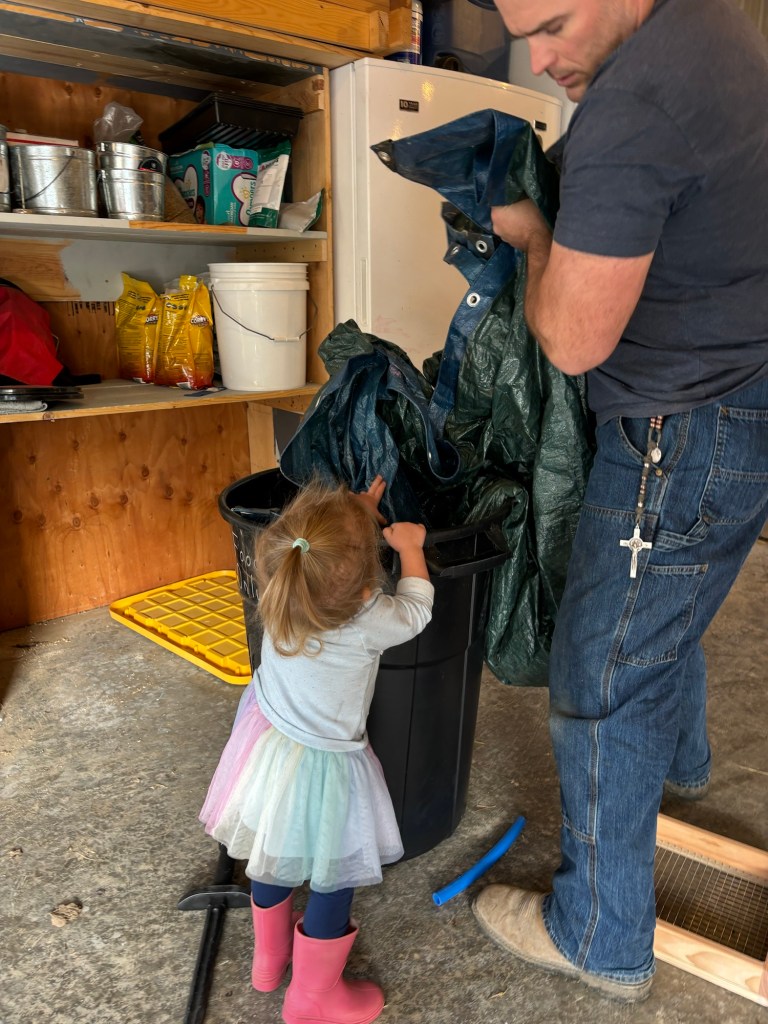
Working out of the garbage pail turned out to be easier than picking it up off the tarp.

After initial screening we winnowed it with the fan. Winnowing it onto a tarp was a good call. It allows us to collect up the fannings and dump them in with the chickens, who can scratch through them to find any lurking buckwheat seeds.

Winnie, “I big help. Winnie know how do it!”

At this stage, a lot depends on small, gentle pushes. The best results happen when small amounts of material fall straight down in front of the fan with minimal forward movement. Then the seeds are more likely to stay in the tub, and the chaff is more likely to be picked up and blown away.

You can see that some of the heavier chaff still falls in the tub on the first winnowing. Also, Winnie is pretty sure this job cannot possibly move forward without her.
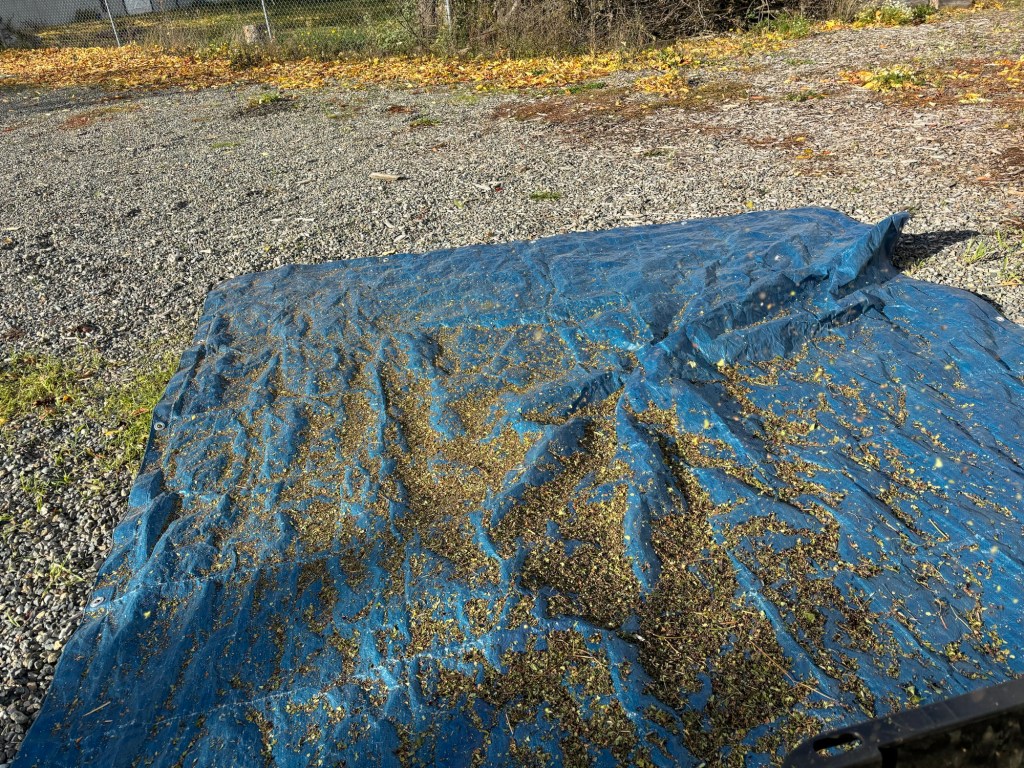
On closer inspection of the fannings, there are some buckwheat seeds in it. The process is not perfect.
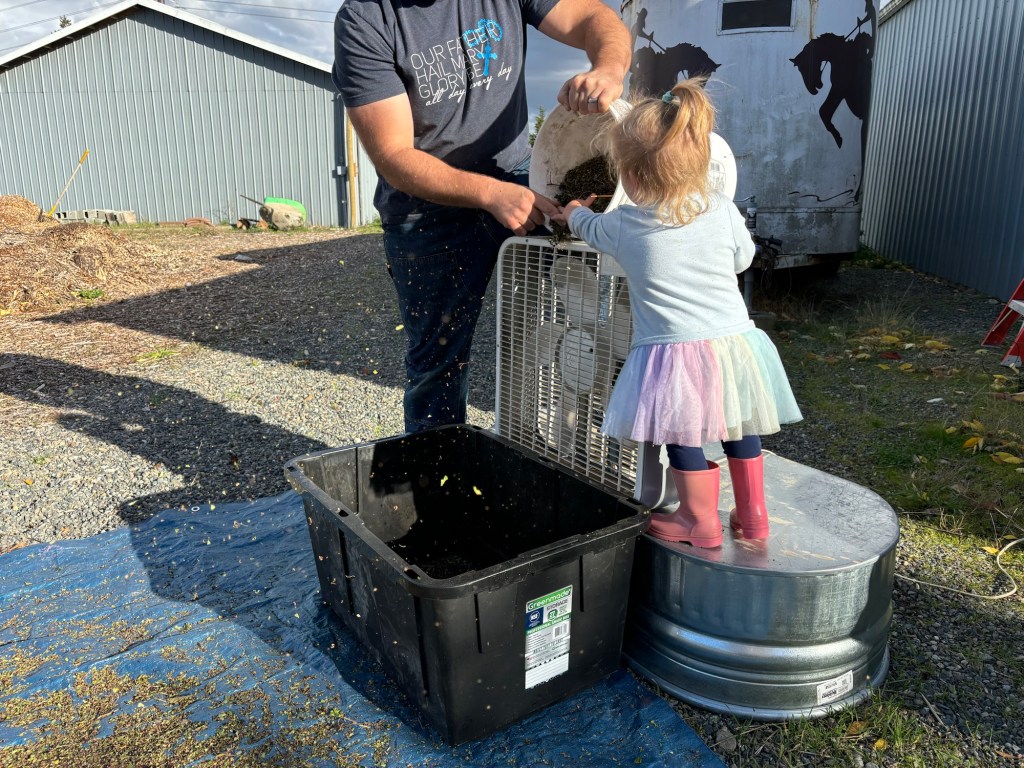
Absolutely determined to be involved.
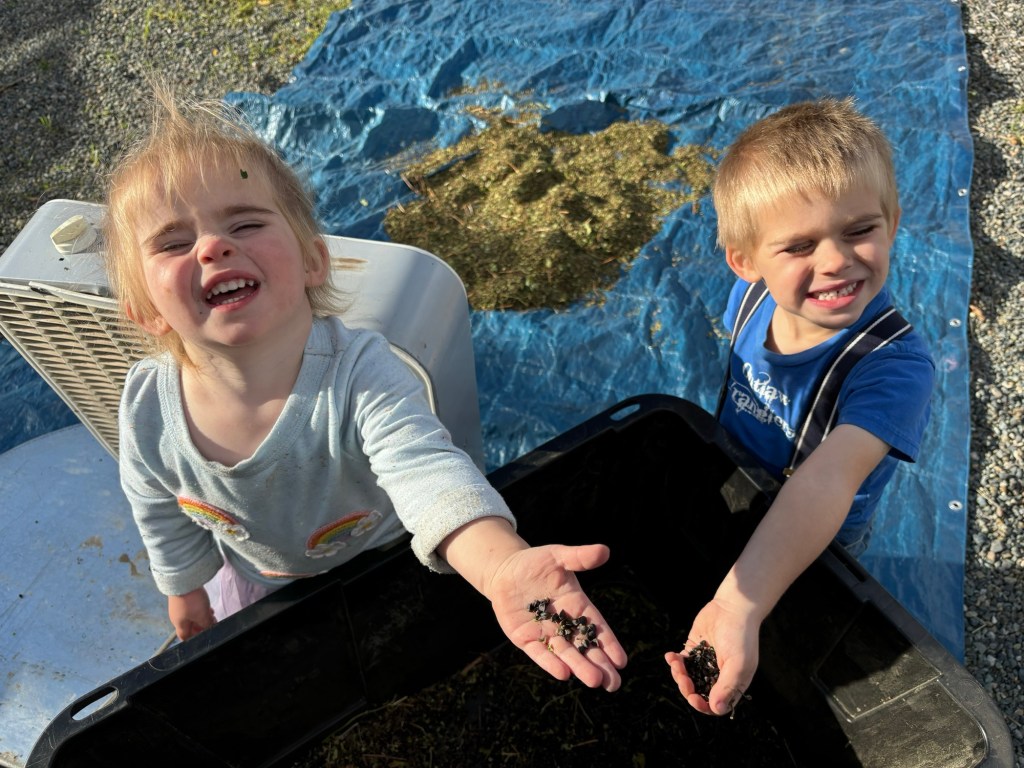
The finished product, buckwheat seeds. We screened them again with one of the fine screens to get much of the dust and small chaff out before winnowing a second time. The result was a much cleaner winnow, though still with some bits of stem and leaf. We could go through and pick these out by hand, but that would be time consuming.
We will most likely simply pick them out when we go to grind them into flour.

 Little Farm in the Big City