

Despite our mixed results with gardening so far this year, phase three of the garden project is finally under way. (Oooh! Phases! They make it sound so official and planned out!)
Really, they are just loose steps in our mental map of getting to where we want to be with the garden (highly productive, renewable, no/low till rotational garden as an integrated component of the total farm ecosystem. Yes, I have been reading books from Chelsea Green publishers. Why do you ask?).
Phase one, the first year, was to carve out the ground with a one-time tillage event (a.k.a., rototill the lawn) mulch and amend, and set up the infrastructure and layout: beds, pathways, irrigation, fences, etc. The first year garden was grown in native soil, heavily mulched with wood chips that had been scratched through and aerated by chickens all winter.
Phase two was to bring the base layer of the beds up to the level of the pathways or higher (you have no idea how difficult it is to weed a bed that is 3-6 inches below the level of the ground you are kneeling on) using the mostly broken down wood chips from the pathway the year before. That is this year’s garden.
It is here that we are running into a snag. The “mostly broken down” wood chips are not, in fact, very broken down at all, despite the injection of two winter’s worth of chicken manure. The fact of the matter is that our soil is too porous and drains too easily, and a lot of our nutrients leach out in the constant rain from September to June. So this brings us to phase three…
Phase three is the beginning of the deep compost beds. This is how we plan to keep a constant stream of nutrients flowing into the garden. This is compost, made with a combination of animal manure (in the form of bedding), straw, yard and garden waste, egg shells and food scraps.
Of course, minerals are going to be a net loss over time because we will be eating them in the form of vegetables, and meat, and because we still insist on using flush toilets. We also export a significant amount of calcium off the farm in the form of egg shells. Some amount of off farm input is inevitable. However, ideally most of it will be in the form of animal feed and minerals, which we can then recycle from their manure and offal. Right now, our small compost bin simply is not equipped to handle a pig’s or cow’s offal, but hopefully when we butcher chickens in about 8 weeks we will be turning yesterday’s compost and can add the chicken offal, feathers, etc to build a new compost pile.
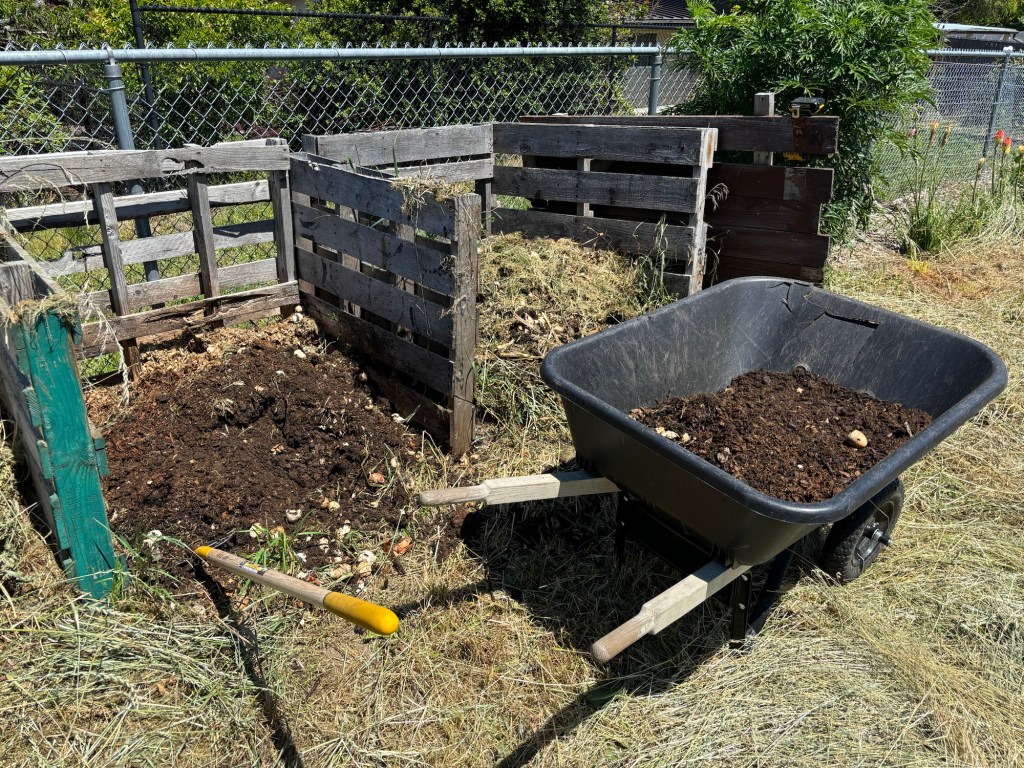
The first step was to clean out the three old, haphazard compost piles (mostly just lawn clippings and food scraps, piled in no particular order) that had built up over the last year-and-a-half. While a good chunk of it was not fully broken down, probably at least 2/3rds by volume, the center of each pile did contain a good amount of well finished compost, enough to fill our 8 cu ft wheelbarrow, and then half fill it. This has been placed on the garden for a late summer seeding of winter brassicas.
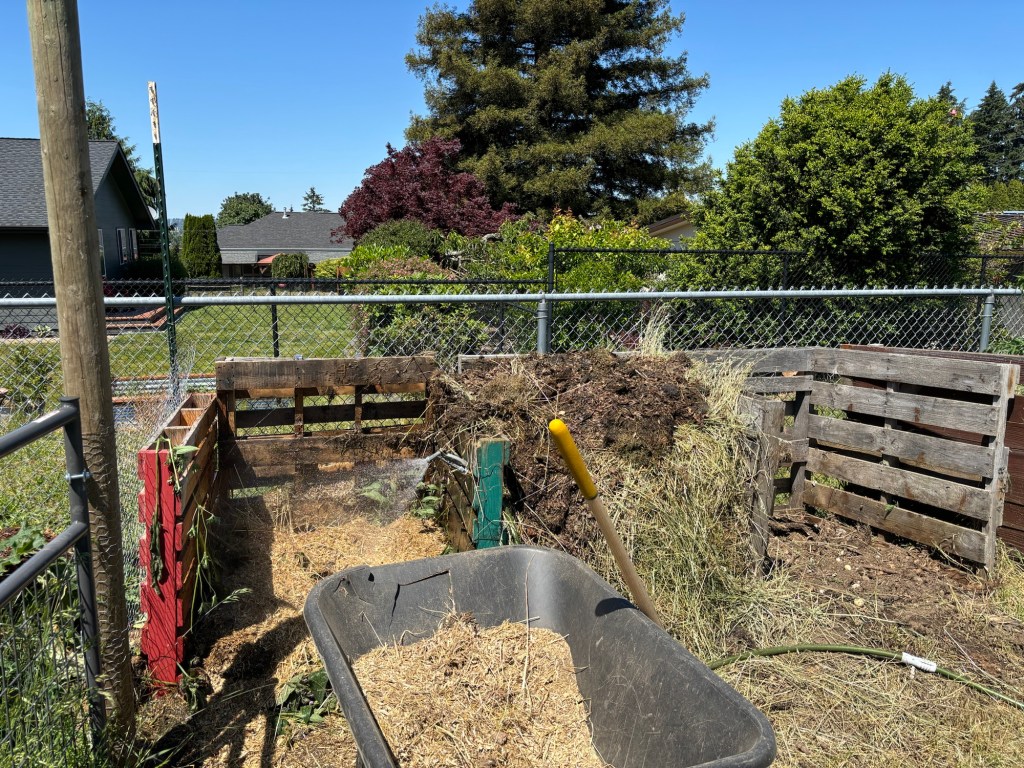
The next step was collecting dry browns, which consisted mainly of straw, chaff, woodchips and chicken droppings from the chicken house, and layering them with wet greens. The greens were about half comfrey from our orchard chopped down the morning of, and the other half grass from the orchard that Uncle cut down with the weed whacker two days prior.
Browns, greens, browns, greens, browns, greens, soaking each layer as we went. At the end of the day, not one, but two compost piles. We will see how they cook down over the next 4-6 weeks, hopefully turn them in about 3-4 weeks and then again 3-4 weeks later, so that we have an empty bin ready to go for chicken butchering time.

 Little Farm in the Big City