

There are two things you must have in place before you can intensively rotate animals on pasture:
- Water
- Control
With the plumbing finished, the yard hydrants connected and operating, and the trench filled in, the pasture set up moves into what we hope will be the final stage before we can put animals onto it: the fencing.
With rotational grazing, most of the control does not come from permanent fencing, but from rapidly movable temporary fences, usually electrical, that can be placed where wanted to create temporary paddocks of the size and shape wanted and in the area wanted.
However, these temporary paddocks are moved around in the context of a larger area, which ought to be bounded by a well-constructed permanent fence. This not only serves to keep predators out, but acts as a back stop in case an animal decides to run through the temporary mobile fencing, as might happen if a fencer runs out of juice, or the fence gets grounded.
We have chosen to make our outer perimeter fence out of woven wire, partially because that was what was already in place, and partially because it is really the most secure fencing option. Being a physical rather than psychological barrier, it does not require the maintenance that an electric or barbed wire fence would require. There are some drawbacks in terms of cost, and initial work installing it, but we hope it will pay for itself in time spent not trimming under it with a weed whacker to keep it from shorting out.
As with any fence made out of wire, tension is key, and the key to tension is a solid anchor. We spent a good deal of time last fall drilling post holes, setting posts in concrete (our soil gets really loose when it rains, which it does 9 months out of every year, so the concrete really helps keep the posts from coming loose. Now, the last thing we need to do before we can stretch fence is turn those wooden fence posts into anchors.

Ideally we would have just loaded everything on the truck as a mobile cut station/cargo hauler and driven out to each spot. Unfortunately, the truck was with Mommy at work, since only the car holds the requisite four car seats. So we walked the 100 yards out to each anchor site, measured, then walked back and did the cutting, then carried the components out to install them.

Naturally that would not be doable on a large property, but on our little three-acre spread, it’s only a little over 100 yards one way, so it was doable.
For most of the corners we did a constructed anchor as shown above, but for the northeastern corner the fence skirts around a little rock pile. There was no good way to tension the wire around two corners like that, so I decided to be a little unorthodox here and build the anchor with horse panels (of which we still have a few lying around from the previous owner.
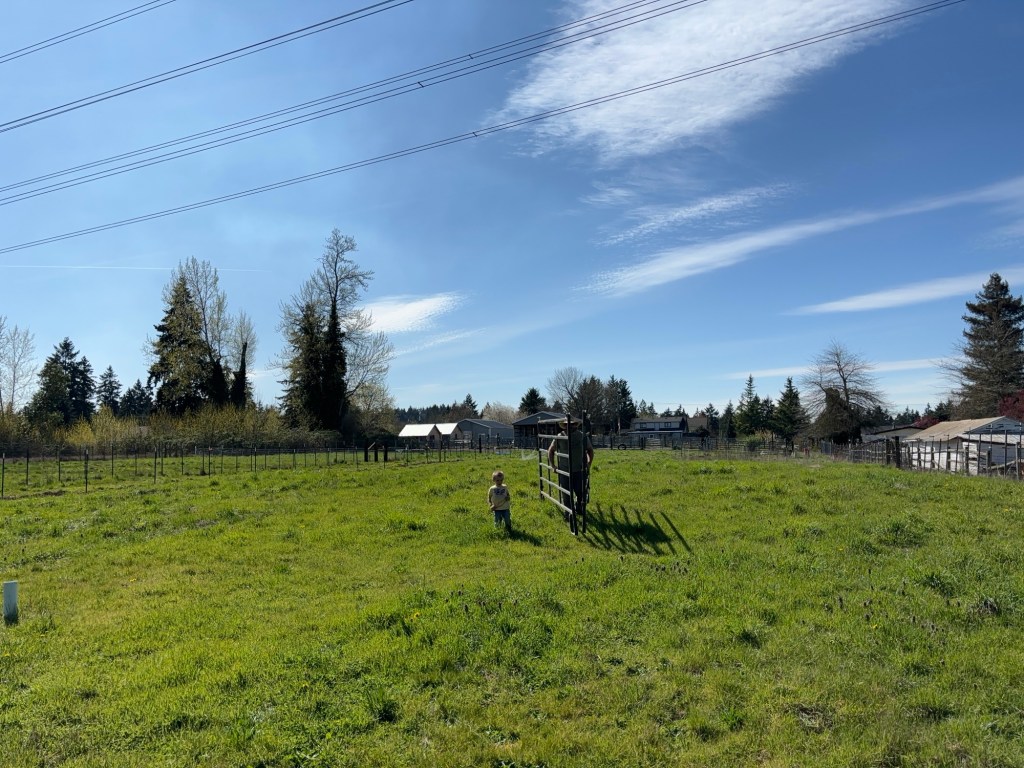
So Seppi and Daddy carried horse panels to the back of the field.

Oof! Not as young as I used to was. I’m going to feel this tomorrow.
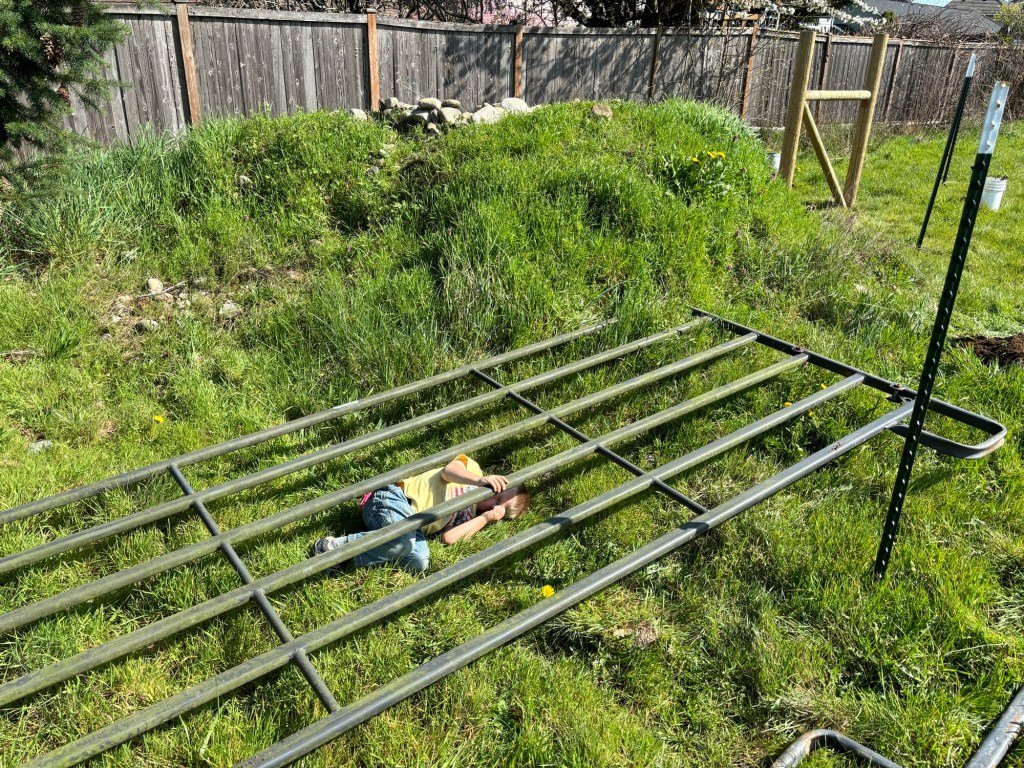
No, Seppi did not get a horse panel dropped on him (not for lack of trying on his part. He had to be yelled at several times to stop climbing on the panels before they were fully secured). He just thought it was funny to crawl under it and pretend to be asleep.

Despite his best efforts, no Seppis were injured in the making of this fence. It would have been nice to put a six foot bar gate in here instead of overlapping two panels, but we didn’t have a bar gat lying around, and weren’t going to pay $450 for one when we really don’t need to go out this corner of the pasture.

The next section was 13 feet long, and the panel was twelve feet. No way to bolt it on both ends effectively, so I bolted it on the side of the anchor which will take most of the strain from stretching the fence, and attached the other side to a T-post. When we attach the woven wire fence we will add some wire ties to transfer tension from the horse panel across the one foot gap to the neighboring wooden post.
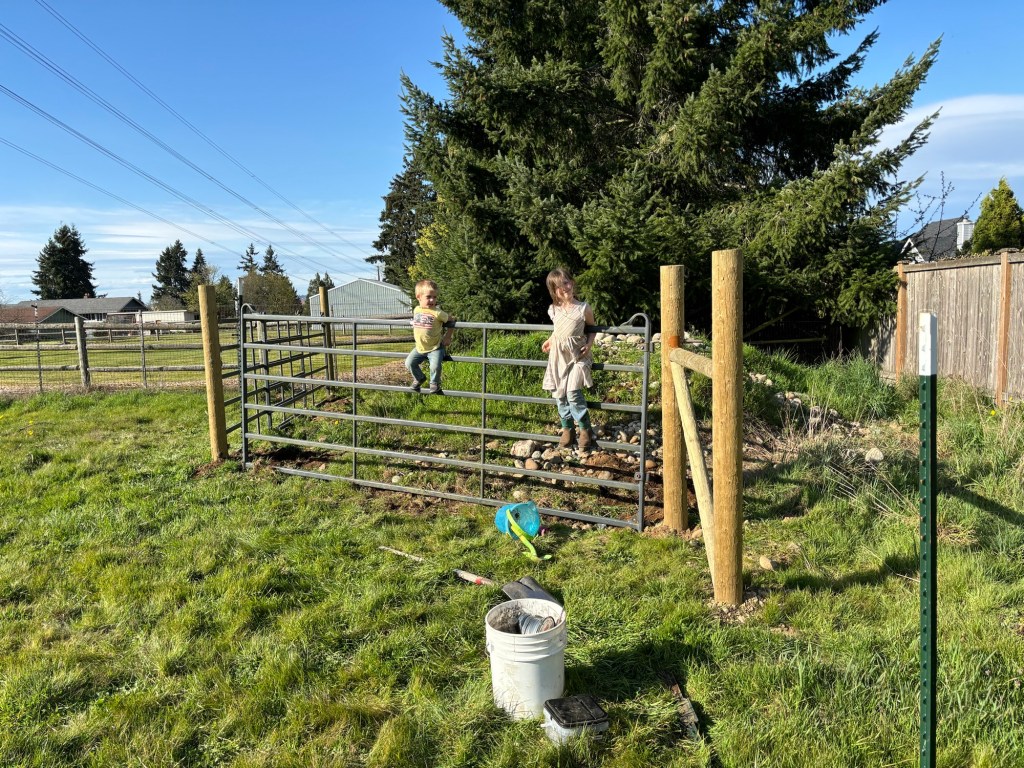
Time to break for supper. This crew ate like a troop of farmers.

After supper the wind picked up and some weather started to roll in, but we got the last anchor built before dark.
Next step, stretch the fence.

 Little Farm in the Big City