

Saturday was a busy day on the farm. We set it aside as the day that the ducks and turkeys would meet their fate.
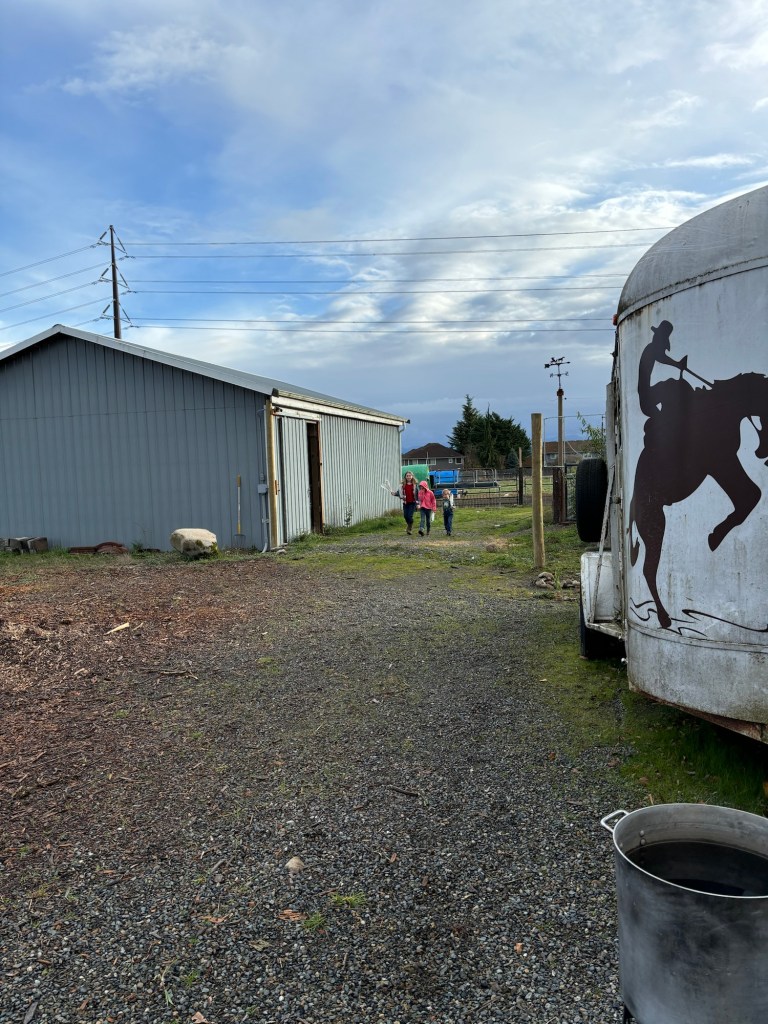
Daddy and the three oldest kids went to the farm to help Uncle, while Mommy and Winnie stayed home to write out school schedules and do some baking.
By the way, if you are offended or made queasy by seeing where your food comes from, this might by the post for you.

The turkeys, of course, were way too big to fit in the restraining cone, but it worked great for the ducks.

The most time-consuming part of processing the birds is plucking them. We decided to hand pluck, rather than use the plucker. The turkeys were way too big, while the ducks had a thick layer of outer feathers, with down on the inside. We couldn’t even scald them until we had dry plucked the outer coat off, because the hot water would have run off them like… well… like water off a duck’s back.
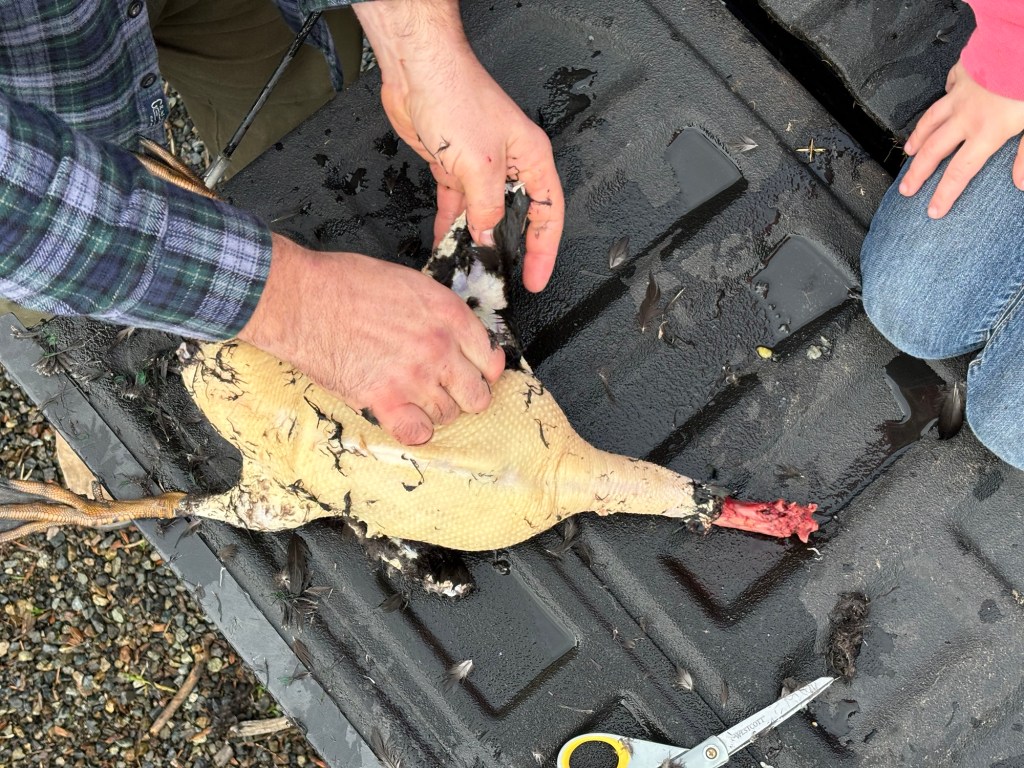
The hardest parts to pluck were the wings (as usual) and the drumsticks just above the lower legs. The skin was not as fragile as the cornish cross, but not as tough as the laying hens, and nearly half an inch thick with fat. Our fear was that the plucker would tear the skin off them with the feathers.
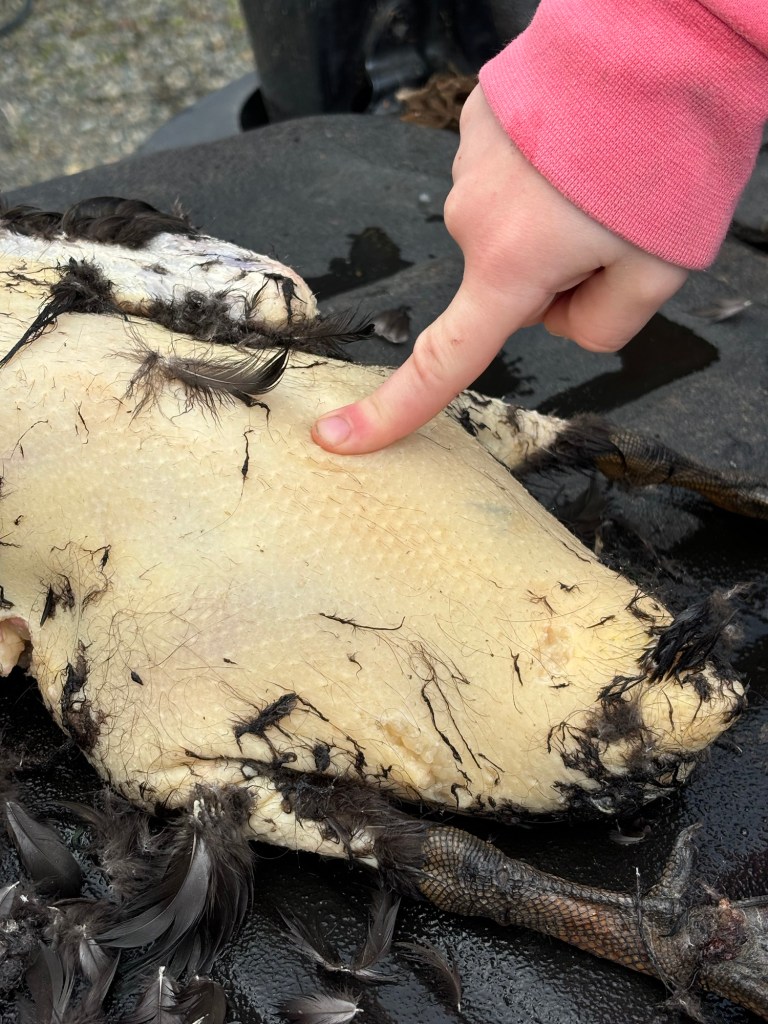
“Look! I found its backbone!”
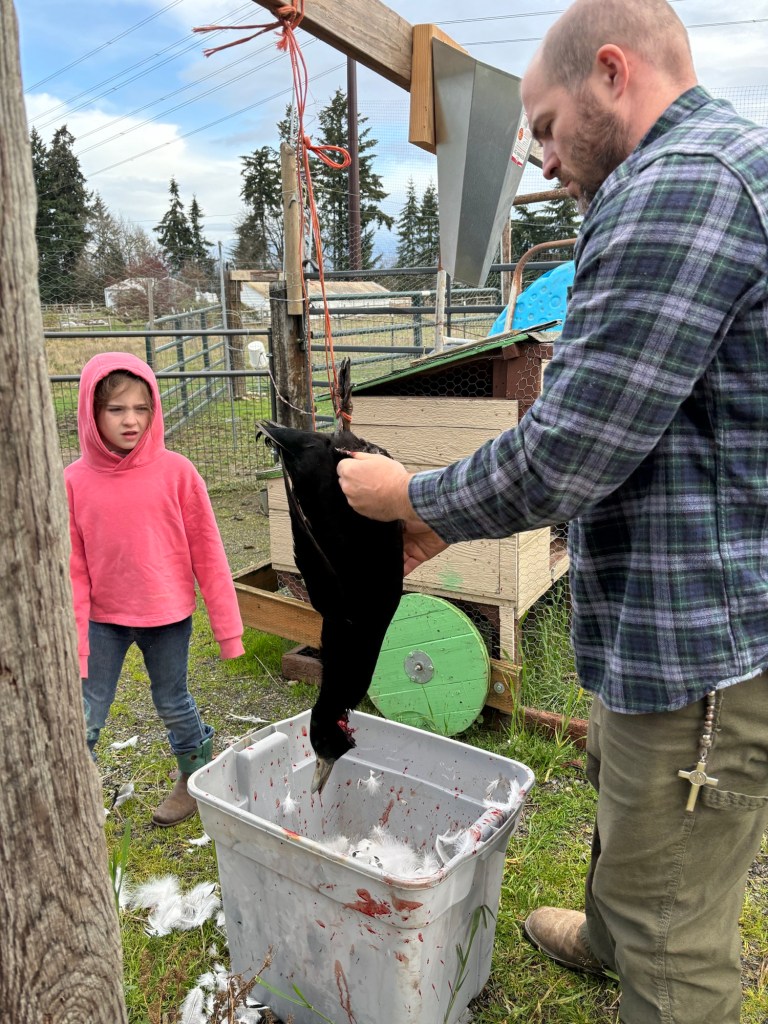
Dry plucking turned out to take quite a while. Next time we’ll try the plucker on the ducks.
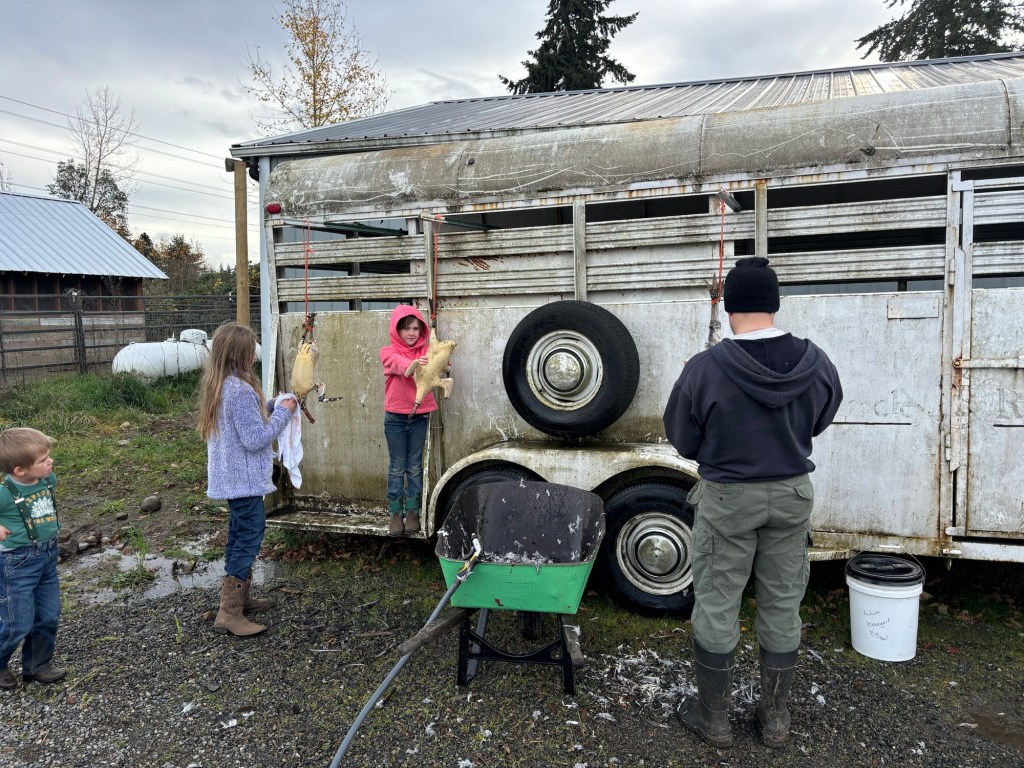
The post scalding pluck on the tailgate of the truck turned out not to be very helpful. What worked best was hanging them from the side of the trailer.

Hanging them by two bale twines to hold the legs apart was the best method.
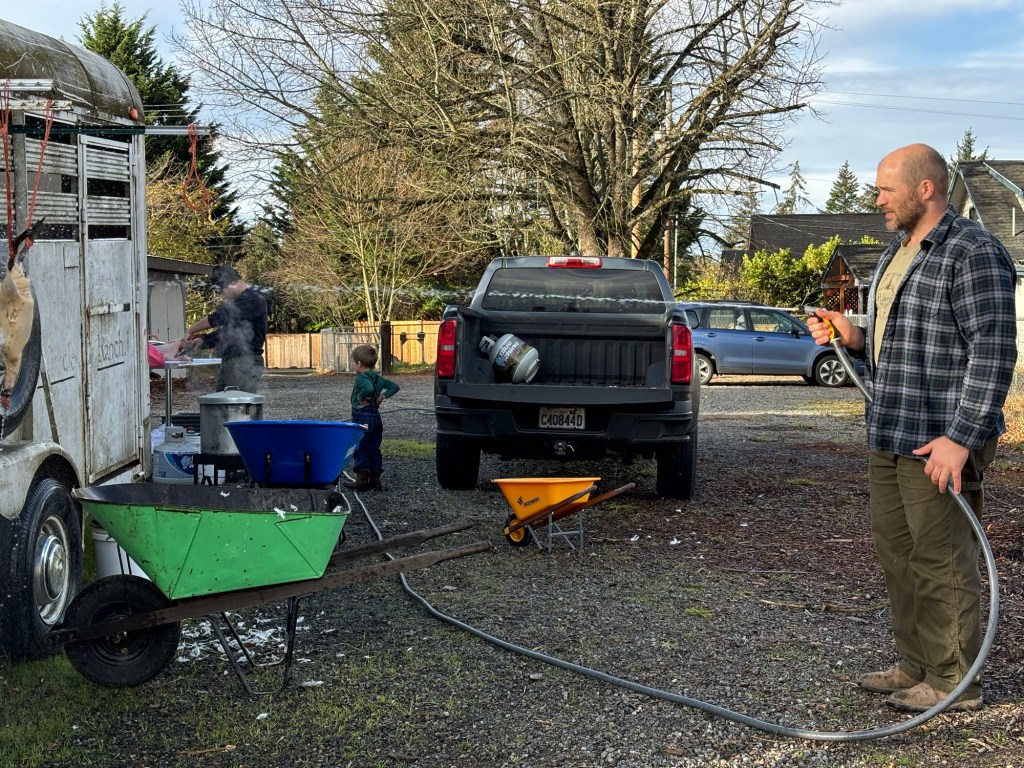
Then after the final pluck we could simply hose them off where they hung.

The kids were there, free to watch or not, help or not just as they pleased.

Big job for a little Ellie. She and Seppi went home with Mommy when she dropped off lunch.

Seppi was only there for the feathers anyway.
After a couple of ducks, Evie asked permission to kill and butcher a duck all by herself. Since she is nine, almost ten, I said yes, although she had to have me there for each major step. She was super excited about it, and ran off to catch her own duck.

She couldn’t reach the top of the restraining cone, so I had to drop it in for her, but then she did all the rest herself.
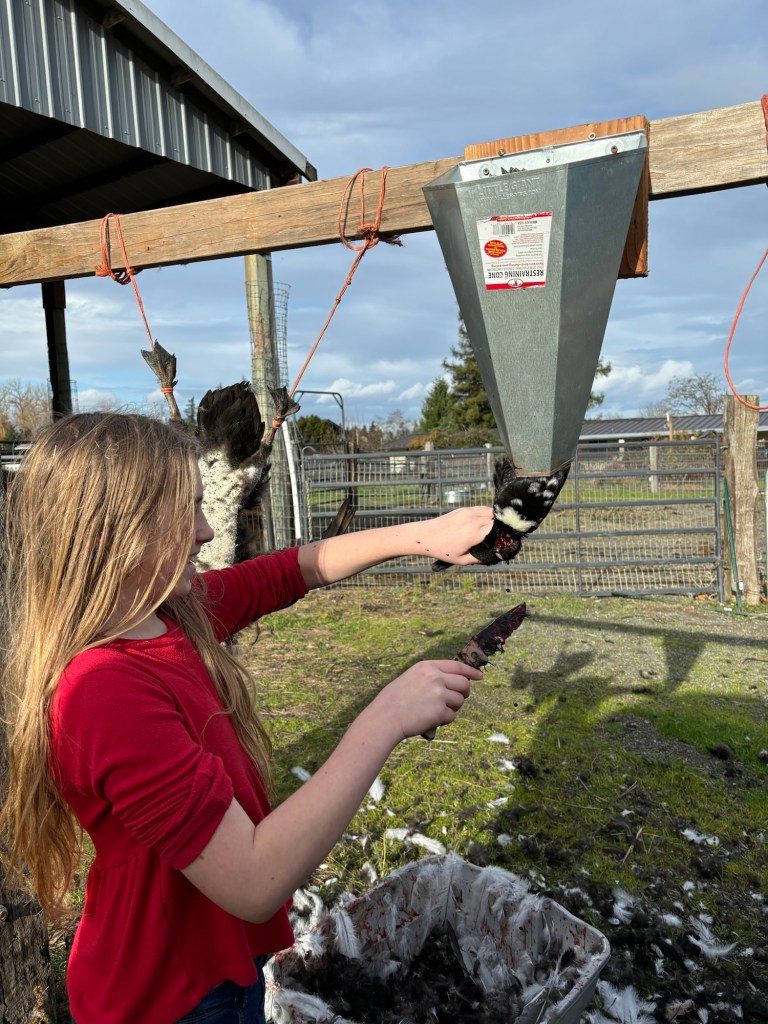
This picture was staged because I had my hand over hers for the actual kill stroke, to make sure that it was quick and accurate.
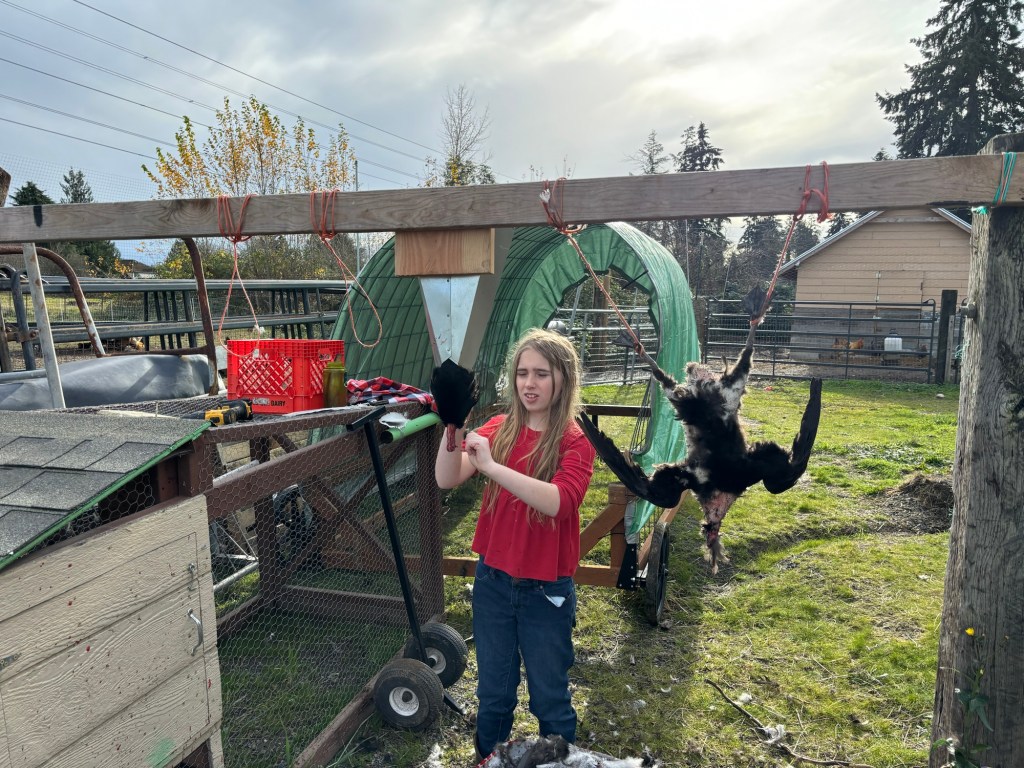
I think she had underestimated how hard a job it is to pluck an entire duck by herself.
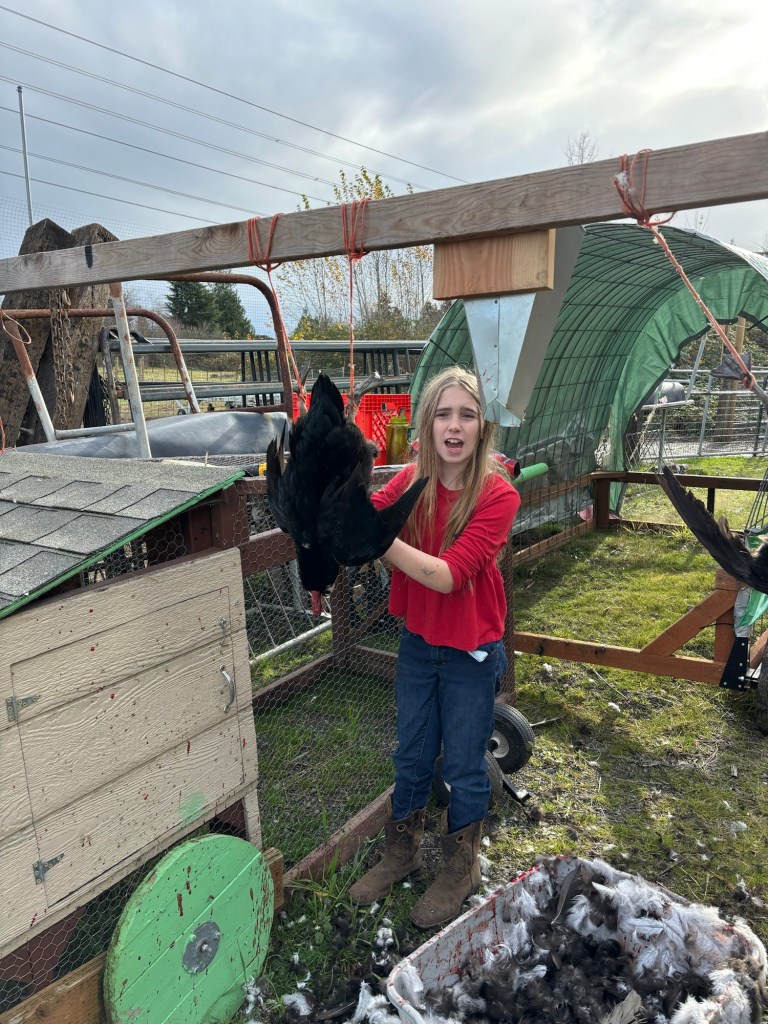
But she took her time with it, and eventually, after about an hour of work, she was able to bring it to the butcher table.
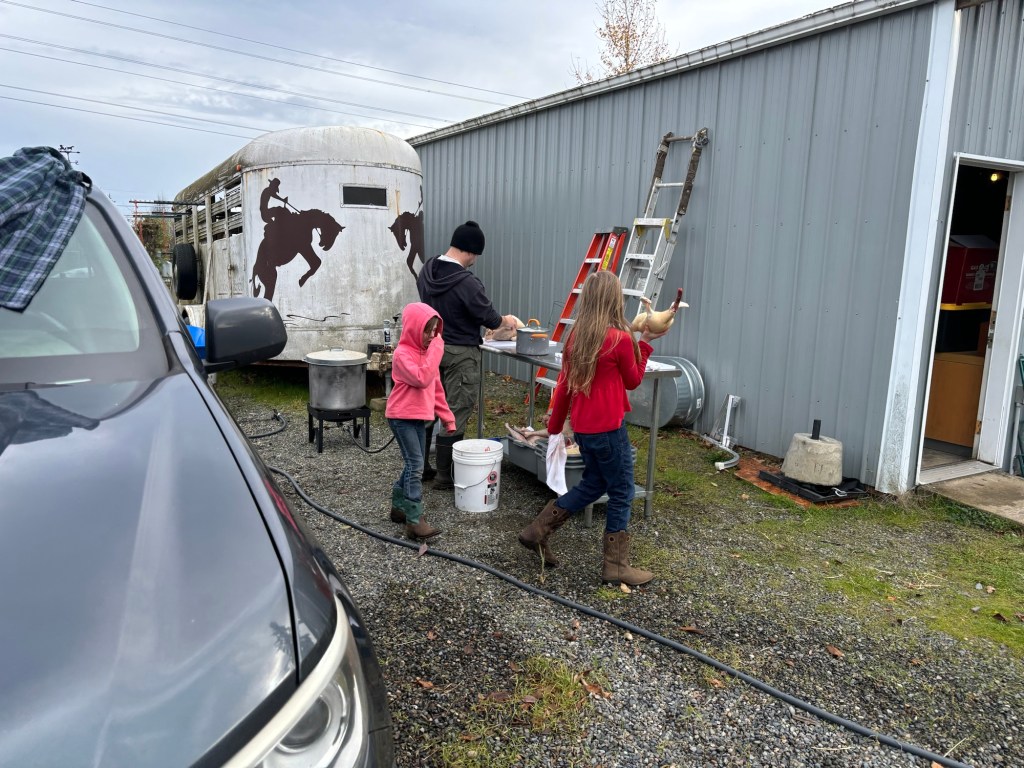
As you can tell from the posture of the carcass, she took long enough that rigor mortis had set in. This isn’t a problem from a food safety perspective, because the ambient temperature was 43 degrees (in fact it was getting colder and starting to rain at this point) but it does make the carcass more challenging to handle.

With minimal demonstration, she got to work removing the neck skin and separating the crop and trachea.

Separating the guts was a bit trickier, and she did tear the gizzard attachment just a touch, so we had to rinse it out thoroughly.

But finally, sticking with it even though her fingers were cold and stiff and tired and her tummy was grumbling for lunch, she finished her first duck. Since she had processed it herself we decided it would be hers to do what she wanted with. She asked if she could donate it to our parish priest, Father Lou, who was more than happy to receive a duck.
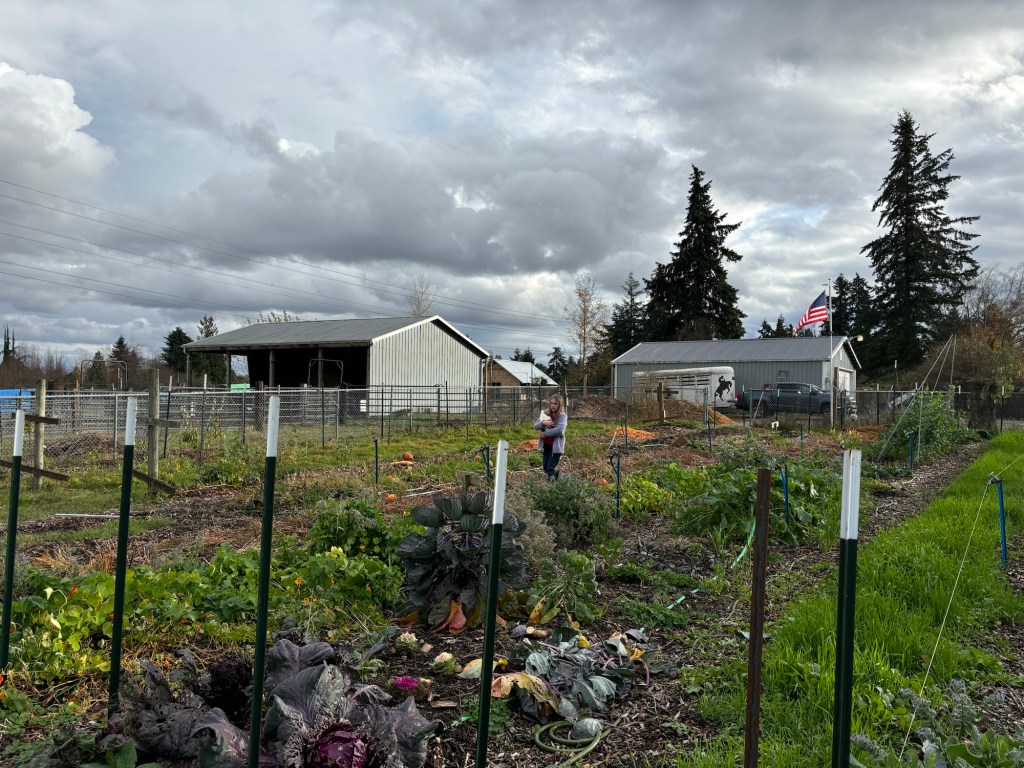
Lastly, we put the three remaining ducks (two Ancona hens and a black drake) into the garden. We want to see if they will forage enough to keep the slug and worm population down, because now that the weather is cold and wet, the slugs are at it again, decimating my winter brassicas. We even have worms eating holes in the rinds of the remaining squashes. God-willing we’ll get them off the ground tomorrow.
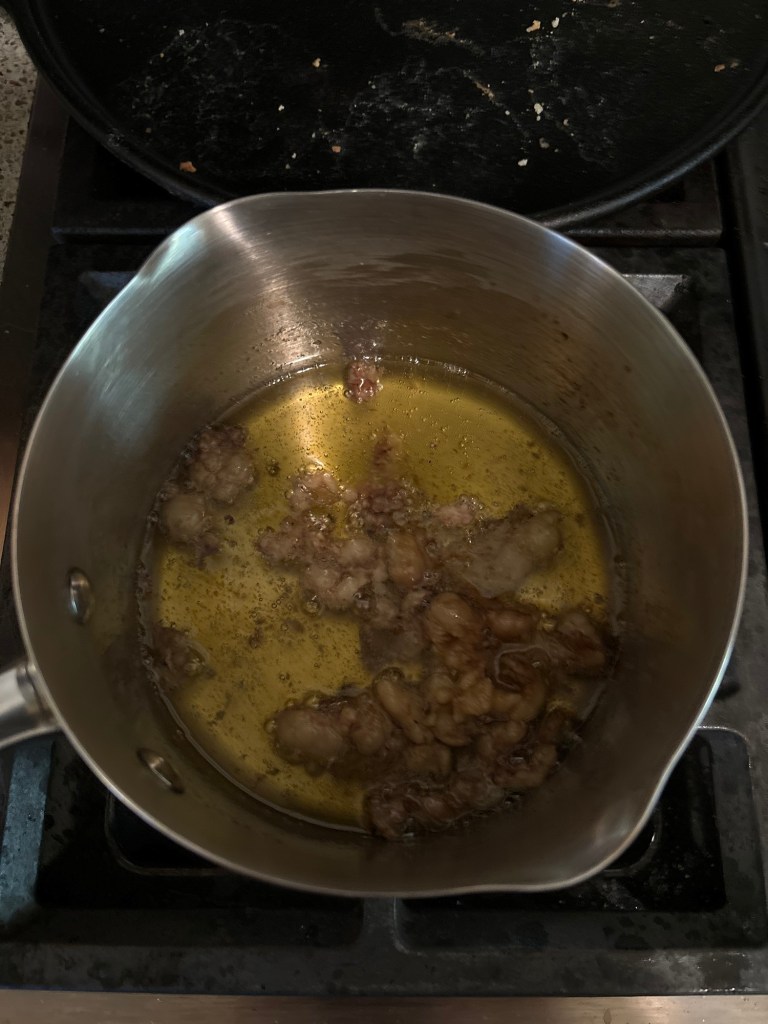
During the butchering process we pulled all the organ fat from the ducks and kept it, and today we rendered it down.

Just under a pint of pure, high quality filtered duck fat.
Lessons learned:
Turkeys
- The weights were disappointing. 200$ of feed and 6 months of pasture raising, and the largest bird was less than 11 Lbs, the smallest just over 5.
- Not sure why this is: a couple of possibilities:
- Heritage breeds, slower growing.
- Heritage breeds, more interested in foraging (they ate the heck out of the grass and bugs) than eating the high energy high protein (high dollar) turkey feed.
- A trend observed among Meishans pigs (in studies, not on our farm) is that their metabolism drops roughly 1% for every percentage of raw roughage added to their diet. Is something like this going on with the Turkeys?
- Of course the real test is the taste. Are these going to be the most delicious turkey-birds ever eaten? at $6/LB to buy and raise them, I sure hope so.
- So for next year, if we decided to do turkeys, we should either buy meat breeds, or keep them off the pasture so they have no choice but to eat the feed. We might also buy them earlier so they have another month or two to pack on the weight. We might not do turkeys at all, we will see.
Ducks:
- Ducks were an afterthought, we got a random mix of leftovers from the hatchery because we needed more birds to make a minimum shipment. None of them were meat birds. They cost $7 apiece.
- We did not keep separate records for their feed (big mistake). Best estimate, the ten of them ate about $300 of feed for the 6 months we had them. $37 dollars per bird, average 3Lbs slaughter weight. We are ballparking about $12.50/Lb, which is not terrible for ducks.
- If we do ducks again we need to plan out and choose our breeds, meat vs. eggs, or plan on maintaining a small forage flock of Anconas, for minimal inputs and just eating what eggs and meat we can get from them for our own consumption.
- They were a pretty low maintenance animal, <5 minutes per day once they were out of the brooder, and they didn’t seem at all interested in swimming or flying.
Wasting too much time on this post. Time to get these savages fed before they mutiny.

 Little Farm in the Big City
1 thought on “Processing Ducks and Turkeys”